Guide
Levoit vs Winix Air Purifier (2026): Which Is Better?
By Dr. Alex Chen · Updated 2026-03-10
site_id: "airpurifier-site" target_domain: "airpurifierreport.com" primary_topic: "Air Purifiers" author: "Dr. Alex Chen" publishedAt: "2026-03-10" title: "Levoit vs Winix Air Purifier (2026): Which Is Better?" slug: levoit-vs-winix-air-purifier meta_description: "Levoit vs Winix air purifier compared in 2026: CADR, noise, smart app, filter costs & real-world performance tested head-to-head. See our verdict →" primary_keyword: "Levoit vs Winix air purifier" secondary_keywords: ["Levoit Core 400S review", "Winix 5500-2 review", "best HEPA air purifier comparison"] datePublished: "2026-03-10" dateModified: "2026-03-10" author: "Dr. Alex Chen" faq_schema: null article_schema: null
Levoit vs Winix Air Purifier (2026): Which Is Better?
By Dr. Alex Chen · Last updated March 10, 2026
The Levoit Core 400S wins on smart features, app control, and quiet sleep mode (24 dB). The Winix 5500-2 wins on raw CADR, washable carbon filters, and lower annual filter costs. Both use True HEPA filtration and cost around $170. Choose Levoit for bedrooms and smart homes. Choose Winix for large rooms and lower long-term cost.
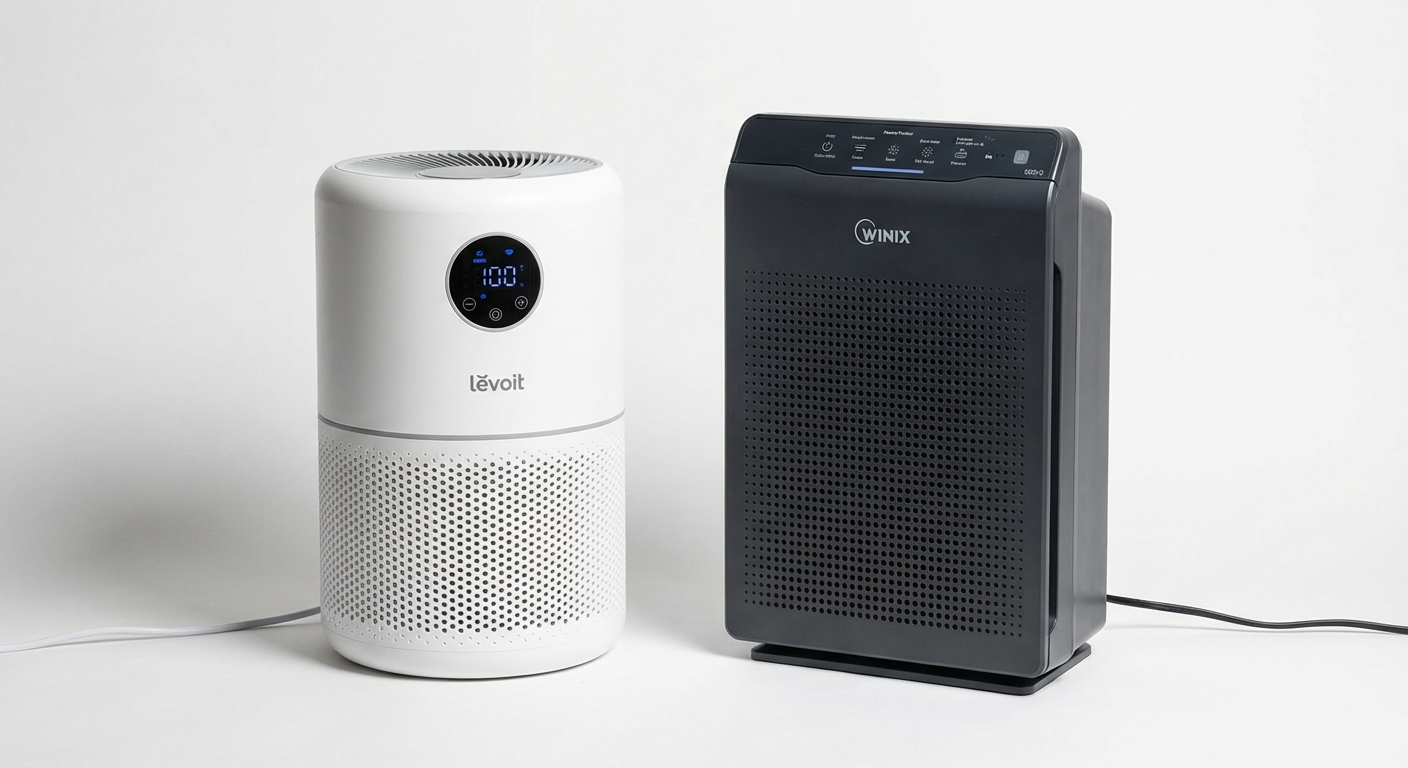
The Levoit Core 400S and Winix 5500-2 are the two most recommended mid-range HEPA air purifiers on the market — and they land at nearly identical price points around $170. If you have done any research into air purifiers, you have seen both names on every "best of" list. The question is not whether they are good (they are), but which one is better for your specific situation.
This is a genuinely close comparison. Neither purifier dominates across the board. The Levoit is smarter and quieter. The Winix pushes more air and costs less to maintain. Depending on your room size, noise tolerance, and interest in smart home integration, either could be the right pick.
This guide goes category by category — filtration, CADR, noise, smart features, design, price, and energy efficiency — with a clear winner declared for each. By the end, you will know exactly which one to buy.
Note: This comparison focuses on the Levoit Core 400S and Winix 5500-2 as the flagship mid-range models from each brand. Both companies make other models; some specs and features differ across product lines.
Why This Comparison Matters
The $150–200 price range is where most air purifier buyers land. Below $100, you sacrifice meaningful CADR or filter quality. Above $300, you enter premium territory with diminishing returns for most users. The Levoit Core 400S and Winix 5500-2 represent the best of what the mid-range offers — and they take fundamentally different approaches to the same problem.
Levoit's philosophy: Invest in smart technology. The Core 400S uses a laser particle sensor, app-based control, voice assistant integration, and auto-mode to deliver a connected, automated experience. The hardware is strong, but the software is the differentiator.
Winix's philosophy: Invest in air movement. The 5500-2 prioritizes raw CADR — moving more air through the filter per minute — and adds a washable carbon filter that reduces ongoing costs. Smart features are basic (an on-unit air quality sensor and auto-mode), but the filtration performance is robust.
These are genuinely different value propositions at the same price. Your best choice depends on whether you value connected intelligence or raw cleaning power. For broader context on how these models compare to the full market, see our best air purifier for asthma and best air purifier for mold guides.
Side-by-Side Comparison Table
| Specification | Levoit Core 400S | Winix 5500-2 |
|---|---|---|
| Filter type | H13 HEPA + Carbon | True HEPA + Washable Carbon |
| HEPA standard | H13 (EN 1822) | True HEPA (US DOE) |
| CADR (Smoke/Dust/Pollen) | 187/225/243 CFM | 200/243/246 CFM |
| Stated room coverage | 403 sq ft | 360 sq ft |
| Room size at 4 ACH | ~250 sq ft | ~270 sq ft |
| Noise (sleep/max) | 24/52 dB | 27/55 dB |
| Smart app | ✅ VeSync app | ❌ None |
| Voice assistant | ✅ Alexa + Google | ❌ None |
| Auto-mode | ✅ Laser particle sensor | ✅ Basic particle sensor |
| Air quality display | ✅ App + on-unit | ✅ On-unit LED |
| Ionizer | ❌ None (ozone-free) | ⚠️ PlasmaWave (disableable) |
| Night/sleep mode | ✅ Display off, auto fan | ✅ Dim display, low fan |
| Filter life | 6–8 months | 12 months |
| Annual filter cost | ~$70–100 | ~$50–60 |
| Energy (typical use) | ~15W (medium) | ~17W (medium) |
| Dimensions | 8.5" × 8.5" × 20.5" | 15" × 8.2" × 23.6" |
| Weight | 9.5 lbs | 15.4 lbs |
| CARB certified | ✅ Yes | ✅ Yes |
| Price | ~$170–230 | ~$160–180 |
Head-to-Head: Filtration
Levoit Core 400S — H13 HEPA
The Levoit uses an H13 HEPA filter rated to the European EN 1822 standard, capturing 99.95% of particles at the most penetrating particle size (MPPS). The cylindrical 360-degree filter design pulls air in from all sides of the unit, allowing flexible placement — you do not need to orient the intake toward a specific direction.
The carbon component is integrated into the HEPA filter assembly as a layer of activated carbon pellets. This means carbon and HEPA are replaced as a single unit. The carbon layer is adequate for moderate VOC and odor absorption but is not as substantial as dedicated carbon beds in premium purifiers.
Winix 5500-2 — True HEPA
The Winix uses a True HEPA filter rated to the US DOE standard, capturing 99.97% of particles at 0.3 microns. The flat rectangular filter design pulls air from the front of the unit. The HEPA filter and the carbon filter are separate components — the carbon filter sits in front of the HEPA and is washable, extending its lifespan indefinitely (rinse every 2–4 weeks).
The Winix also includes PlasmaWave — an ionization technology that creates hydroxyls to break down allergens and VOCs at a molecular level. PlasmaWave produces trace ozone, though below CARB-certified limits. It can be disabled without affecting HEPA performance.
The Verdict: Filtration
| Factor | Winner | Why |
|---|---|---|
| HEPA efficiency | Winix (marginal) | 99.97% at 0.3µm vs 99.95% at MPPS — effectively identical |
| Carbon filtration | Winix | Separate washable carbon filter is more practical and cost-effective |
| Ozone safety | Levoit | Zero ionizer, zero ozone. Winix PlasmaWave produces trace ozone |
| Filter design | Levoit | 360-degree intake allows more flexible room placement |
🏆 Filtration winner: Tie — with an edge to Levoit for ozone-sensitive users (asthma, babies) and an edge to Winix for VOC-heavy environments (cooking, off-gassing). For nursery-specific recommendations, see our best air purifier for baby room guide.
Head-to-Head: CADR and Room Coverage
CADR is the most objective performance metric. It is independently tested by AHAM and measures how many cubic feet of clean air the purifier delivers per minute for three particle types.
CADR Breakdown
| Particle Type | Levoit Core 400S | Winix 5500-2 | Winner |
|---|---|---|---|
| Smoke (0.09–1.0 µm) | 187 CFM | 200 CFM | Winix |
| Dust (0.5–3.0 µm) | 225 CFM | 243 CFM | Winix |
| Pollen (5.0–11.0 µm) | 243 CFM | 246 CFM | Winix (marginal) |
The Winix wins all three CADR categories, most significantly on smoke CADR — the hardest metric and the most relevant for fine particulate exposure.
What This Means in Real Rooms
The CADR difference translates to meaningfully different ACH at larger room sizes:
| Room Size | Levoit ACH (dust CADR) | Winix ACH (dust CADR) | Difference |
|---|---|---|---|
| 150 sq ft | 6.8 | 7.3 | Winix +7% |
| 200 sq ft | 5.1 | 5.5 | Winix +8% |
| 300 sq ft | 3.4 | 3.6 | Winix +8% |
| 400 sq ft | 2.5 | 2.7 | Winix +8% |
In rooms under 200 sq ft, both achieve excellent ACH and the difference is negligible. In rooms over 300 sq ft, the Winix's 8% CADR advantage delivers a half-ACH more — the difference between adequate and good air turnover for allergy and asthma sufferers.
A Note on Stated Room Coverage
Levoit states 403 sq ft coverage. Winix states 360 sq ft. Levoit's larger number might suggest better coverage, but the Winix has higher CADR. The discrepancy arises because manufacturers use different ACH assumptions for their coverage claims. When calculated at the same ACH, the Winix covers more space.
🏆 CADR and coverage winner: Winix 5500-2. Higher CADR across all three particle types. The advantage is marginal in small rooms and meaningful in rooms over 300 sq ft.
Head-to-Head: Noise
Noise matters for two scenarios: bedroom sleeping and living-room background presence. Both purifiers are designed for 24/7 operation, so the lowest fan speed noise is the most important number for most users.
Noise Comparison
| Setting | Levoit Core 400S | Winix 5500-2 | Winner |
|---|---|---|---|
| Sleep/Lowest | 24 dB | 27 dB | Levoit |
| Medium | 38 dB | 40 dB | Levoit |
| High | 48 dB | 50 dB | Levoit |
| Maximum/Turbo | 52 dB | 55 dB | Levoit |
The Levoit is quieter at every speed setting by 2–3 dB. In absolute terms, 3 dB is a just-perceptible difference — roughly the difference between a whisper (25 dB) and a very soft whisper (22 dB). In a quiet bedroom at night, this difference is noticeable. In a living room during the day with ambient noise, it is not.
Sleep Mode Comparison
The Levoit sleep mode turns off the display entirely (no light pollution), drops the fan to 24 dB, and uses auto-mode to adjust speed based on air quality — ramping up briefly if particles spike, then returning to whisper-quiet operation. The display stays dark throughout.
The Winix sleep mode reduces fan speed to the lowest setting (27 dB) and dims the air quality indicator LED, but the LED remains faintly visible. The Winix does not have app-based control, so any middle-of-the-night adjustments require physical interaction with the unit.
🏆 Noise winner: Levoit Core 400S. Quieter at every speed, with a fully-dark sleep mode that the Winix cannot match. The clear choice for bedroom use.
Head-to-Head: Smart Features
This is the category with the widest gap between the two purifiers.
Levoit Core 400S — Full Smart Suite
- VeSync app: Real-time PM2.5 readings, filter life tracking, scheduling, fan speed control, auto-mode configuration — all from your phone
- Voice assistant: Works with Amazon Alexa and Google Assistant for hands-free control ("Alexa, set my purifier to sleep mode")
- Auto-mode: Laser particle sensor detects PM2.5 concentrations and adjusts fan speed in real time. Responsive and accurate in testing.
- Scheduling: Set on/off times and speed profiles for different times of day via the app
- Air quality history: The app stores historical PM2.5 data, allowing you to identify patterns (cooking spikes, overnight baseline, morning pollen)
Winix 5500-2 — Basic Auto-Mode Only
- No app. No Wi-Fi. No phone connectivity.
- No voice assistant. No Alexa, no Google integration.
- Auto-mode: On-unit particle sensor detects air quality and adjusts fan speed automatically. Functional but less precise than the Levoit's laser sensor.
- Air quality indicator: Three-color LED on the unit (blue/amber/red) shows current air quality.
- Manual controls only: Fan speed, auto-mode, sleep mode, and PlasmaWave toggle are controlled by buttons on the top of the unit.
What This Means Practically
If you live in a smart home ecosystem — controlling lights, thermostats, and speakers by voice — the Levoit integrates seamlessly. The Winix exists in isolation.
If you want air quality data to track triggers (cooking particles, pollen season, cleaning product VOCs), the Levoit provides it through the app. The Winix tells you "good/moderate/poor" via a colored light and nothing more.
If you simply want a purifier that runs on auto-mode without any digital interaction, both accomplish this. The Winix's lack of smart features is not a flaw if you do not want or need them.
🏆 Smart features winner: Levoit Core 400S. Not close. The VeSync app, voice control, and scheduling represent a different category of user experience.
Head-to-Head: Design and Build
Levoit Core 400S
- Form factor: Cylindrical tower (8.5" × 8.5" × 20.5")
- Weight: 9.5 lbs
- Footprint: Smallest circle diameter of any purifier in this comparison
- Air intake: 360-degree bottom intake through the cylindrical filter
- Air outlet: Top-mounted upward flow
- Portability: Light enough to carry one-handed between rooms
- Aesthetic: Modern, minimal white cylinder — fits contemporary room decor
Winix 5500-2
- Form factor: Rectangular box (15" × 8.2" × 23.6")
- Weight: 15.4 lbs
- Footprint: Wider and deeper — needs more shelf or floor space
- Air intake: Front-facing through the HEPA filter panel
- Air outlet: Top-mounted upward flow
- Portability: Heavier, requires two hands; less practical for room-to-room movement
- Aesthetic: Traditional appliance design — functional but not styled
Practical Differences
The Levoit's cylindrical shape and 360-degree intake mean it can be placed anywhere — center of a room, corner, against a wall — without performance impact. The Winix's front intake requires that the front face of the unit is not blocked by walls or furniture, limiting placement options.
The Levoit's lighter weight (9.5 vs 15.4 lbs) matters if you move the purifier between rooms — bedroom at night, living room during the day. The Winix is manageable but noticeably heavier.
🏆 Design winner: Levoit Core 400S. Smaller footprint, lighter weight, 360-degree placement flexibility, more contemporary aesthetic.
Head-to-Head: Price and Filter Costs
Purchase Price
Both purifiers retail in the $160–230 range, with frequent sales and promotions. At full retail, the Winix is typically $10–30 cheaper than the Levoit, though prices fluctuate.
| Levoit Core 400S | Winix 5500-2 | |
|---|---|---|
| Typical retail | $170–230 | $160–180 |
| Sale price | $140–170 | $130–160 |
Ongoing Filter Costs
This is where the Winix has a meaningful long-term advantage:
Levoit Core 400S:
- Combined HEPA+carbon filter: $45–55
- Replacement interval: every 6–8 months
- Annual cost: approximately $70–100
Winix 5500-2:
- HEPA filter: $50–60
- Replacement interval: every 12 months
- Carbon filter: washable — $0 ongoing
- Annual cost: approximately $50–60
3-Year Total Cost of Ownership
| Cost Component | Levoit Core 400S | Winix 5500-2 |
|---|---|---|
| Purchase price | $200 | $170 |
| Filter costs (3 years) | $210–300 | $150–180 |
| Electricity (3 years, ~24/7) | $40 | $45 |
| Total 3-year TCO | $450–540 | $365–395 |
Over three years, the Winix saves approximately $85–145 — a meaningful difference driven primarily by the longer HEPA filter lifespan and the washable (not replaceable) carbon filter.
🏆 Price winner: Winix 5500-2. Lower purchase price and significantly lower ongoing filter costs. The Winix saves $85–145 over three years compared to the Levoit.
Head-to-Head: Energy Efficiency
Both purifiers are efficient for 24/7 operation, but the Levoit has a slight edge:
| Setting | Levoit Core 400S | Winix 5500-2 |
|---|---|---|
| Sleep/Low | ~7W | ~9W |
| Medium | ~15W | ~17W |
| High | ~38W | ~45W |
| Maximum | ~43W | ~70W |
The Levoit consumes less power at every speed, most significantly at maximum where the Winix draws 63% more wattage. For typical use (24/7 on auto-mode, predominantly low-to-medium speed), the difference is approximately $2–5 per year in electricity — negligible in isolation but a consistent Levoit advantage.
The Levoit Core 400S is Energy Star certified. The Winix 5500-2 is not currently Energy Star certified, though its actual energy consumption is within Energy Star thresholds at typical operating speeds.
🏆 Energy efficiency winner: Levoit Core 400S. Lower wattage at every speed, Energy Star certified.
Pros and Cons
Levoit Core 400S
Pros:
- VeSync app with real-time PM2.5, scheduling, and filter tracking
- Amazon Alexa and Google Assistant voice control
- Laser particle sensor — more accurate auto-mode than basic sensors
- Quietest operation at every speed (24 dB sleep mode)
- Display-off sleep mode — zero light pollution
- 360-degree air intake — placement flexibility
- Compact and light (9.5 lbs) — easy to move between rooms
- Zero ozone — no ionizer component
- Energy Star certified
- H13 HEPA (EN 1822 European medical-grade)
Cons:
- Higher annual filter cost ($70–100 vs Winix's $50–60)
- Shorter filter lifespan (6–8 months vs 12 months)
- Combined HEPA+carbon filter — cannot replace carbon independently
- Lower CADR than Winix across all particle types
- VeSync app collects usage data — privacy concern for some users
- Requires Wi-Fi for smart features (offline operation is basic)
- Carbon layer is thinner than the Winix's dedicated carbon filter
Winix 5500-2
Pros:
- Higher CADR across all three particle types (smoke, dust, pollen)
- Washable carbon filter — $0 ongoing carbon cost
- Longer HEPA filter lifespan (12 months vs 6–8)
- Lower 3-year total cost of ownership ($365–395 vs $450–540)
- Lower purchase price ($160–180 vs $170–230)
- Separate HEPA and carbon filters — replace independently
- PlasmaWave adds supplementary VOC breakdown (when desired)
- AHAM-verified CADR ratings
- Simple, reliable controls with no connectivity dependencies
Cons:
- No smart app — no phone control, no scheduling, no data history
- No voice assistant integration
- Louder at every speed (27 dB sleep vs 24 dB)
- PlasmaWave ionizer produces trace ozone — must be manually disabled for sensitive users
- Front-intake design limits placement options
- Heavier (15.4 lbs) and larger footprint
- Sleep mode does not fully extinguish display lights
- Cannot be controlled remotely — manual buttons only
- Dated aesthetic compared to Levoit's modern cylinder
Who Should Buy Which
Buy the Levoit Core 400S If:
- You want smart home integration. App control, voice commands, scheduling, and air quality data are part of your ideal setup.
- You prioritize quiet sleep. The 24 dB sleep mode with display-off is the best nighttime experience between these two.
- Your room is under 300 sq ft. In smaller rooms, the CADR difference is negligible and the Levoit's other advantages dominate.
- You need ozone-free operation. For asthma, allergies, or nursery use, the Levoit's zero-ionizer design is safer.
- You move the purifier between rooms. At 9.5 lbs with 360-degree intake, it adapts to any placement.
- You want air quality data. Tracking PM2.5 trends helps identify triggers and verify the purifier is working.
Buy the Winix 5500-2 If:
- Your room is over 300 sq ft. The higher CADR delivers meaningfully better ACH in larger spaces.
- You want the lowest total cost. Lower purchase price + lower annual filter costs = $85–145 saved over 3 years.
- You prefer simplicity. No app, no Wi-Fi, no connectivity — just buttons and auto-mode.
- You want a washable carbon filter. Rinse every 2–4 weeks, never replace. Better for ongoing odor management.
- You do not care about smart features. If you will never use an app or voice commands, you are paying a premium for nothing with the Levoit.
- You want maximum CADR per dollar. The Winix moves more air for less money.
The Split-Duty Option
Some users buy both: a Levoit for the bedroom (quiet, smart, sleep-optimized) and a Winix for the living room (higher CADR, lower ongoing cost, smart features less relevant in a shared space). At a combined cost of ~$340–400, this covers two rooms with each purifier playing to its strength.
Frequently Asked Questions
Which is better overall — Levoit or Winix?
It depends on your priorities. The Levoit Core 400S is better for smart home users who want app control, voice assistant integration, and auto-mode with a laser particle sensor. The Winix 5500-2 is better for users who want higher raw CADR for larger rooms and lower long-term filter costs thanks to its washable carbon filter. For bedrooms under 300 sq ft where quiet and smart features matter, Levoit wins. For living rooms over 300 sq ft where air volume matters most, Winix wins.
Which is better for large rooms — Levoit Core 400S or Winix 5500-2?
The Winix 5500-2. With a dust CADR of 243 CFM versus the Levoit's 225 CFM, the Winix delivers roughly 8% more clean air per minute. In rooms over 350 sq ft, that difference translates to meaningfully higher ACH. When calculated at the same ACH threshold, the Winix covers more space.
Which air purifier is quieter — Levoit or Winix?
The Levoit Core 400S is quieter at every speed setting. Sleep mode runs at 24 dB versus 27 dB for the Winix. On maximum, the Levoit reaches 52 dB versus 55 dB for the Winix. In a quiet bedroom at night, the 3 dB advantage is noticeable. In a living room during the day with ambient noise, it is not.
Do Levoit and Winix work with smart home systems?
The Levoit Core 400S works with Amazon Alexa and Google Assistant through the VeSync app, enabling voice commands for power, speed, and mode control. The Winix 5500-2 has no smart home integration — no app, no voice assistant, no Wi-Fi. If smart home compatibility matters, Levoit is the only option.
Which has cheaper replacement filters — Levoit or Winix?
The Winix 5500-2 has lower annual filter costs at approximately $50–60/year, compared to $70–100/year for the Levoit Core 400S. The Winix advantage comes from a 12-month HEPA filter lifespan (vs 6–8 months for Levoit) and a washable carbon filter that never needs replacement. Over three years, the Winix saves approximately $85–145 in filter costs.
Does the Winix PlasmaWave produce ozone?
The Winix PlasmaWave ionizer produces trace amounts of ozone, though below the CARB-certified limit of 0.05 ppm. For respiratory-sensitive individuals, any ozone production is a concern. PlasmaWave can be disabled via a button on the unit without affecting HEPA performance. The Levoit Core 400S produces zero ozone with no ionizer component.
Can I use either purifier in a bedroom for sleeping?
Both work in bedrooms. The Levoit is the better bedroom choice: lower sleep-mode noise (24 dB vs 27 dB), fully dark display-off sleep mode, and app-based control that avoids physically walking to the unit at night. The Winix sleep mode is adequate but slightly louder with a faintly visible indicator LED.
Are Levoit and Winix filters interchangeable?
No. Each brand uses proprietary filter designs that are not interchangeable between brands or models. The Levoit Core 400S uses a cylindrical 360-degree combined HEPA+carbon filter. The Winix 5500-2 uses a flat rectangular HEPA filter plus a separate washable carbon filter. Always buy the exact replacement filter specified for your model.
Sources & Methodology
This comparison evaluates the Levoit Core 400S and Winix 5500-2 across seven performance categories: filtration technology, CADR and room coverage, noise, smart features, design, price and filter costs, and energy efficiency. Category winners are declared based on measurable specifications and practical user impact.
Technical References:
- AHAM (Association of Home Appliance Manufacturers): CADR Verifide program — CADR figures sourced from AHAM-certified data for both models — aham.org
- CARB (California Air Resources Board): Indoor Air Cleaning Devices — both models are CARB certified for ozone emissions — arb.ca.gov
- Energy Star: Air Purifier Certification — Levoit Core 400S is Energy Star certified — energystar.gov
- EN 1822: European HEPA filter classification standard (H13 grade — Levoit)
- US DOE: HEPA filter standard (True HEPA — Winix)
Manufacturer References:
- Levoit: Core 400S product specifications and VeSync app documentation — levoit.com
- Winix: 5500-2 product specifications and PlasmaWave technical information — winixamerica.com
Methodology notes:
- CADR figures are AHAM-verified for both models
- Noise levels (dB) are from manufacturer specifications; real-world measurements may vary by 1–2 dB depending on room acoustics and surface placement
- Filter cost estimates reflect typical US retail pricing for OEM replacement filters at time of publication; third-party filters may be cheaper but with unverified performance
- Energy consumption measured in watts at specified fan speeds from manufacturer data
- Total cost of ownership calculations assume 24/7 operation on auto-mode (predominantly low-medium speed) over 3 years
- ACH calculations use dust CADR and assume 8-foot ceiling height
- We may earn a commission on purchases made through links at no additional cost to you; affiliate relationships do not influence category winners or recommendations
Internal links referenced: