Guide
Best Air Purifier for Baby Room (2026)
By Dr. Alex Chen · Updated 2026-03-10
By Dr. Alex Chen · Last updated March 10, 2026
The best air purifier for a baby room is the Coway Airmega 150 — True HEPA filtration at just 22 dB in sleep mode, California CARB certified ozone-free, covering nurseries up to 214 sq ft. For budget-conscious parents, the Levoit Core Mini at 25 dB offers H13 HEPA with a built-in night light for under $50.
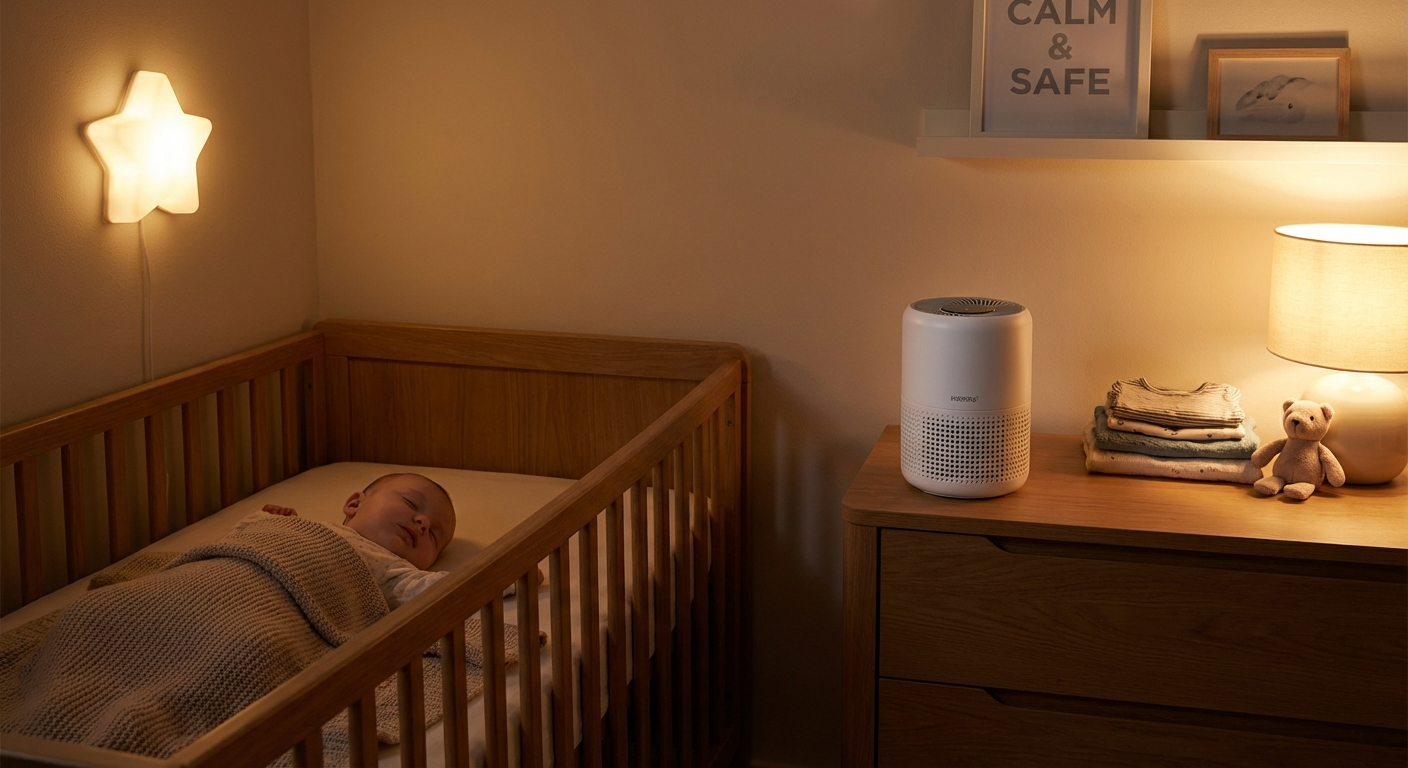
Your baby breathes 30–60 times per minute — roughly twice the rate of an adult. Every breath pulls in whatever is floating in the nursery air: dust mite allergens, pet dander, mold spores, pollen that drifted in through a window, fine particles from cooking, and volatile organic compounds off-gassing from new furniture, paint, and flooring.
An infant's lungs are still developing. Their airways are narrower. Their immune systems are immature. The air quality that an adult tolerates without symptoms can genuinely stress a baby's respiratory system. This is why pediatric health organizations recommend keeping nursery air as clean as possible — and why a HEPA air purifier is one of the most practical tools for doing so.
But not every air purifier belongs in a baby's room. Ionizers produce ozone. Loud fans disrupt sleep. Unstable designs create tipping hazards. This guide evaluates 5 purifiers through the lens that matters most to parents: Is it safe? Is it quiet enough for sleep? Does it actually clean the air?
Medical note: This guide provides evidence-based information about nursery air quality. It is not medical advice. For concerns about your baby's respiratory health, consult your pediatrician. The American Academy of Pediatrics (AAP) offers guidance on creating safe sleep environments.
Why Nursery Air Quality Matters
Infant Lungs Are Uniquely Vulnerable
Babies are not small adults — their respiratory systems are physiologically different in ways that make air quality disproportionately important:
Higher breathing rate. Newborns take 30–60 breaths per minute compared to 12–20 for adults. Per unit of body weight, babies inhale significantly more air — and therefore more airborne contaminants — than adults in the same room.
Narrower airways. Infant airways are proportionally smaller, meaning even minor inflammation from airborne irritants can cause noticeable breathing difficulty. What causes mild irritation in an adult can cause audible congestion or wheezing in an infant.
Developing immune system. A newborn's immune system is still learning to distinguish harmful substances from harmless ones. Early exposure to high concentrations of airborne allergens may influence the development of allergic sensitization, though research on this is ongoing.
More time in one room. Babies spend 12–17 hours per day sleeping, most of it in the nursery. The air quality in this single room has an outsized impact on their total daily exposure.
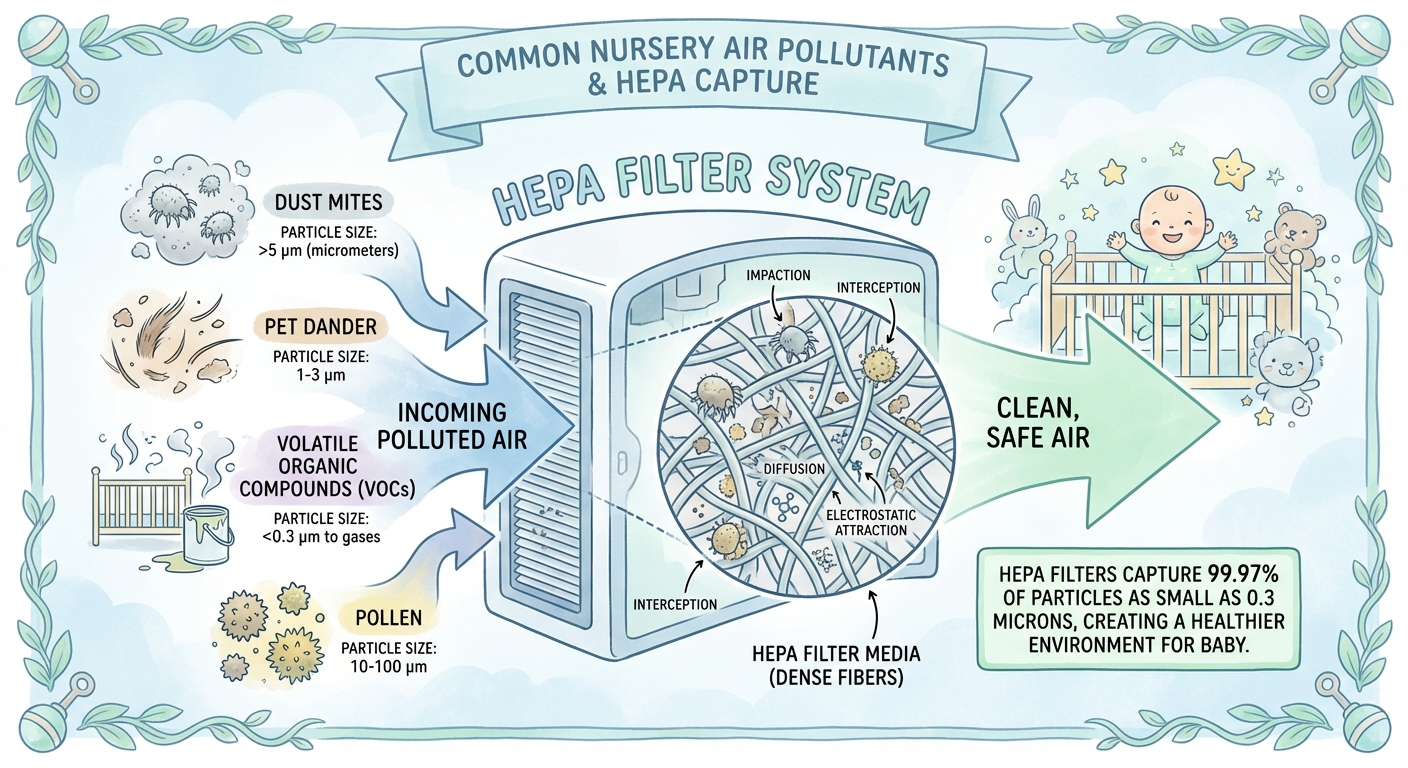
Common Nursery Air Pollutants
| Pollutant | Source | Size | HEPA Captures? |
|---|---|---|---|
| Dust mite allergens | Bedding, carpet, stuffed animals | 10–40 µm | ✅ Yes |
| Pet dander | Pets in the home | 2.5–10 µm | ✅ Yes |
| Mold spores | Moisture in walls, window condensation | 1–20 µm | ✅ Yes |
| Pollen | Open windows, carried on clothing | 10–100 µm | ✅ Yes |
| PM2.5 (fine particles) | Cooking, candles, outdoor pollution | <2.5 µm | ✅ Yes |
| VOCs (gases) | New furniture, paint, cleaning products | Gas phase | ❌ Carbon filter needed |
For detailed guidance on mold-specific air purification, see our best air purifier for mold guide.
The Three Non-Negotiables for Baby Room Purifiers
Before evaluating features, specs, or price, every baby room air purifier must meet three absolute requirements:
1. Zero Ozone Emission
Ozone (O₃) is a lung irritant. In adults, it causes coughing and airway inflammation. In infants with developing lungs, the risk is amplified. The EPA explicitly warns against ozone generators in occupied spaces, and the AAP's guidance on infant environments emphasizes minimizing respiratory irritant exposure.
What produces ozone in air purifiers:
- Ionizers (ionic purifiers)
- UV-C light chambers (some models)
- Plasma generators
- Electrostatic precipitators
What does NOT produce ozone:
- Mechanical HEPA filters
- Activated carbon filters
- Fan-based purifiers with no electrical air treatment
How to verify: Look for CARB (California Air Resources Board) certification, which limits ozone output to 0.05 ppm. Better yet, choose a purifier with no ionizer component at all. Every purifier in this guide meets this standard.
2. Sleep-Compatible Noise (Under 30 dB)
The AAP recommends keeping nursery noise levels below 50 dB to protect infant hearing development. But for sleep, the practical threshold is much lower. Most sleep-trained babies sleep through consistent noise below 35 dB, and the quietest purifiers operate at 22–25 dB — softer than a whisper.
Importantly, many parents find that a quiet air purifier doubles as a white noise machine. The consistent low hum masks household sounds (dogs barking, doors closing, older siblings playing) that would otherwise wake a sleeping baby. This is an unintended but genuinely valuable benefit.
3. Physical Safety
A nursery air purifier must be:
- Stable — cannot be tipped by a crawling baby or pulled by a toddler
- Cord-safe — power cord must be secured against the wall, out of reach
- Cool-running — no hot surfaces accessible to a child
- No small parts — no removable buttons, caps, or filters accessible without tools
Comparison Table: 5 Best Air Purifiers for Baby Rooms
| Air Purifier | Filtration | CADR | Sleep Noise | Room Size | Ozone-Free | Night Light | CARB Certified | Price | Best For |
|---|---|---|---|---|---|---|---|---|---|
| Coway Airmega 150 | True HEPA + Carbon | 90 CFM | 22 dB | 214 sq ft | ✅ No ionizer | ❌ No | ✅ Yes | ~$160 | Best overall nursery pick |
| Levoit Core Mini | H13 HEPA | 78 CFM | 25 dB | 178 sq ft | ✅ No ionizer | ✅ Yes (color) | ✅ Yes | ~$50 | Best budget + night light |
| Dyson Pure Cool Me | HEPA + Carbon | 56 CFM | 27 dB | Personal (~50 sq ft) | ✅ No ionizer | ❌ No | ✅ Yes | ~$350 | Best targeted airflow |
| Blueair Blue Pure 411 Auto | HEPASilent | 120 CFM | 23 dB | 190 sq ft | ✅ No ionizer | ❌ No | ✅ Yes | ~$120 | Best smart auto-mode |
| Honeywell HPA100 | True HEPA | 100 CFM | 35 dB | 155 sq ft | ✅ No ionizer | ❌ No | ✅ Yes | ~$90 | Best budget True HEPA |
All five purifiers are CARB certified. Four operate below 30 dB on their lowest setting; the Honeywell HPA100 operates at 35 dB — within the AAP's recommended nursery noise range.
Detailed Reviews
1. Coway Airmega 150 — Best Overall for Nursery
Why it wins for baby rooms: The Airmega 150 combines the quietest operation on this list (22 dB — nearly inaudible) with True HEPA filtration and zero ozone production. At 214 sq ft coverage, it handles the largest nurseries with room to spare, delivering strong ACH even on low speed. The compact footprint (13.4" × 7.1" × 16.8") fits on a dresser or bookshelf without dominating the room.
Coway's air quality indicator LED changes color based on real-time particulate levels — a useful visual cue for parents. The LED can be dimmed or turned off entirely for nighttime use, eliminating light disruption during sleep.
Pros:
- Quietest on this list at 22 dB — barely perceptible even in a silent nursery
- True HEPA + activated carbon filtration
- CARB certified, no ionizer — zero ozone
- Air quality indicator with dimmable LED
- Compact, stable base — low tipping risk
- Filter replacement indicator prevents expired filter use
- Eco mode reduces energy consumption when air is clean
Cons:
- No night light function — requires a separate night light if needed
- No smart app — manual controls only
- Higher price (~$160) than budget options
- Carbon pre-filter is thin — limited VOC absorption for off-gassing furniture
- No handle — less convenient to move between rooms
- White body shows dust and scuffs over time
Best for: Parents who prioritize the absolute quietest operation for sleep-trained babies. The 22 dB sleep noise is the gold standard in this category. If your baby is a light sleeper, start here.
2. Levoit Core Mini — Best Budget + Night Light
Why it is ideal for nurseries: The Core Mini is purpose-built for small rooms and does something no other purifier on this list does: it includes a built-in color night light with adjustable brightness. For nurseries where parents want a single device that purifies air and provides a soft ambient glow for nighttime feeding and diaper changes, the Core Mini eliminates the need for a separate night light.
At under $50, it is the most affordable purifier in this guide by a wide margin. The H13 HEPA filter meets the European medical-grade standard (99.95% at MPPS), and Levoit's entire product line is ozone-free with no ionizer components. The 25 dB sleep mode is whisper-quiet.
The Core Mini also includes an aromatherapy function — a small pad where you can add essential oil drops that the airflow diffuses into the room. A word of caution: many pediatricians recommend against using essential oils around infants under 6 months. If you use this feature, consult your pediatrician first and use only baby-safe oils in minimal quantities.
Pros:
- Most affordable option at ~$50 — low-risk purchase
- Built-in night light with adjustable colors and brightness
- H13 HEPA filtration — European medical-grade standard
- Ozone-free, no ionizer across the entire Levoit product line
- Ultra-compact (6.3" × 6.3" × 10.4") — fits anywhere
- 25 dB sleep mode
- Aromatherapy pad (optional use — see pediatrician guidance for infants)
Cons:
- Smallest coverage area (178 sq ft) — adequate for most nurseries but tight for larger rooms
- No air quality sensor — runs at set speed regardless of air conditions
- Carbon filter is minimal — negligible VOC absorption
- No smart app on the Mini model (available on Core Mini+)
- Plastic build — less durable than the Coway
- Filter replacement every 6 months at ~$15 per filter
- Aromatherapy feature may not be appropriate for infants under 6 months
Best for: Budget-conscious parents who want a combined purifier and night light. At $50, it costs less than many standalone night lights combined with a basic fan. Ideal for standard-sized nurseries (100–150 sq ft).
3. Dyson Pure Cool Me — Best Targeted Airflow
Why it is relevant for nurseries: The Pure Cool Me is a personal air purifier — designed to deliver clean air to a specific zone rather than purifying an entire room. For a nursery, this means you can position it to direct purified air toward the crib area, creating a clean-air envelope around your sleeping baby.
The Core Flow technology projects a focused stream of purified air using a dome-shaped diffuser. The airflow is gentle enough not to create a draft that disturbs sleep, and the oscillation function sweeps the clean air across the crib area. The HEPA + carbon filter combination captures both particulate and gaseous pollutants.
The premium price (~$350) is the major tradeoff. For the cost of one Dyson Pure Cool Me, you could buy a Coway Airmega 150 and a Levoit Core Mini — covering both the nursery and a second room.
Pros:
- Targeted airflow creates a clean-air zone around the crib
- HEPA + activated carbon filtration
- No ionizer, zero ozone
- LCD display shows air quality (can be dimmed for night use)
- Quiet operation at 27 dB on low
- Premium build quality — stable, no accessible small parts
- Oscillation distributes clean air across crib area
Cons:
- Personal purifier — covers approximately 50 sq ft effectively, not the full room
- Most expensive on this list at ~$350
- CADR is not published — Dyson does not participate in AHAM testing
- Filter replacement is expensive (~$40 per filter, every 12 months)
- Does not purify the full nursery — parents in the room still breathe unfiltered air
- Overkill for most nurseries where a room purifier delivers better overall value
- Display light, while dimmable, cannot be fully turned off on all settings
Best for: Parents who want to create the cleanest possible air zone directly around the crib and are willing to pay a premium for targeted delivery. Best used alongside a room-level purifier rather than as the only nursery purifier.
4. Blueair Blue Pure 411 Auto — Best Smart Auto-Mode
Why it works for nurseries: The 411 Auto is the only purifier on this list with genuine smart auto-mode — it detects particulate concentration in real time and adjusts fan speed automatically. For a nursery, this means the purifier ramps up when air quality drops (diaper change, someone entering the room, cooking odors drifting in) and returns to ultra-quiet operation when air is clean.
The HEPASilent technology combines mechanical HEPA filtration with an electrostatic pre-filter. Unlike ionic air purifiers, the Blue Pure 411 Auto does not produce ozone — there is no ionizer component. The unit is CARB certified and ozone-free, making it safe for nursery use.
The colored LED ring on top provides an at-a-glance air quality indicator — green (clean), yellow (moderate), red (poor). This visual feedback gives parents confidence that the purifier is responding to air quality changes.
Pros:
- Smart auto-mode — adjusts to real-time air quality without intervention
- Colored air quality indicator ring — intuitive visual feedback
- HEPASilent delivers good CADR at low noise
- Energy Star certified — efficient for 24/7 operation
- 23 dB on lowest setting — excellent for sleep
- Washable pre-filter (fabric sleeve) — reduces ongoing costs
- Compact cylinder design with small footprint
Cons:
- No night light
- No app connectivity on the 411 Auto (available on 411i Auto)
- Fabric pre-filter sleeve shows dirt and requires periodic washing
- Carbon filtration is minimal — limited VOC absorption
- Auto-mode may ramp fan speed audibly during nighttime air quality changes
Best for: Parents who want set-and-forget operation with automatic air quality response. Best for parents who want set-and-forget operation with automatic air quality response and are comfortable with smart auto-mode. If you prefer the absolute simplest controls, choose the Coway or Honeywell instead.
5. Honeywell HPA100 — Best Budget True HEPA
Why it is a strong nursery pick: The HPA100 is a straightforward True HEPA purifier from a trusted brand at a genuinely accessible price (~$90). No ionizer. No UV-C. No smart features or complexity. Just a mechanical HEPA filter, a carbon pre-filter, and a fan. For parents who want proven, uncomplicated air cleaning, the HPA100 delivers exactly that.
At 155 sq ft coverage, it handles standard nurseries (100–150 sq ft) with adequate ACH. The turbo clean mode provides rapid air cleaning when needed — useful after painting, assembling furniture, or vacuuming the nursery. Sleep mode at 35 dB is quiet enough for most babies, though not as silent as the Coway's 22 dB.
Pros:
- True HEPA — certified 99.97% at 0.3 microns
- No ionizer, no UV-C — zero ozone, zero complexity
- Budget-friendly at ~$90
- Turbo clean mode for rapid air clearing
- CARB certified
- Trusted household brand — filters widely available at retail stores
- Simple controls — no app or connectivity to troubleshoot
Cons:
- Turbo mode is loud (58 dB) — not suitable during sleep
- No air quality sensor or auto-mode
- No night light
- Boxy design — less aesthetically nursery-friendly
- Carbon pre-filter is thin — minimal VOC and odor absorption
- 35 dB on low is noticeably louder than the Coway (22 dB) or Blueair (23 dB)
- No dimming — indicator lights stay on continuously
Best for: Budget-conscious parents who want a name-brand True HEPA purifier with no ozone risk and no complexity. The best option if you want to spend under $100 and still get genuine HEPA performance. Pair with a separate white noise machine if your baby needs lower background sound.
Nursery Placement and Safety Guide
Where to Place the Purifier
Distance from crib: Position the purifier at least 3 feet from the crib. This prevents direct airflow onto the baby (which can cause drying of nasal passages) and keeps the unit out of reach once the baby can stand and grab.
Elevation: Place on a dresser or sturdy shelf at mid-room height when possible. Purifiers at floor level pull in settled dust effectively, but elevated placement provides better overall room circulation and keeps the unit away from crawling babies.
Airflow path: Do not place the purifier in a corner blocked by furniture. It needs clear space around the air intake and outlet (typically 12–18 inches) to circulate air effectively. Against a wall with the outlet facing the room center is ideal.
Cord Safety
Power cords are a strangulation and tripping hazard. Secure the cord:
- Against the wall using cord clips or cable channels
- Behind furniture where the baby cannot reach
- Away from the crib — never run a cord near or under the crib
Consider a cord cover or raceway for the section between the outlet and the purifier. These cost $5–10 and eliminate the exposed cord entirely.
When Baby Starts Moving
Once your baby begins crawling (typically 6–10 months), reassess purifier placement:
- Move to a higher surface out of reach
- Ensure the purifier cannot be pulled down by its cord
- Check that the unit is stable and cannot tip if bumped
- Verify no small parts (filter access panels, buttons) are accessible
Understanding Ozone and CARB Certification
Why Ozone Matters More for Babies
Ozone irritates the respiratory lining at any age. For infants, the risk is amplified by three factors:
- Higher relative dose. Babies breathe more air per pound of body weight. The same room ozone concentration delivers a proportionally larger dose to infant lungs.
- Developing airways. Infant airways are actively growing and forming. Irritant exposure during this period may have developmental effects that would not occur in mature adult airways.
- No avoidance capacity. An adult who smells ozone can leave the room. A baby in a crib cannot.
CARB Certification Explained
CARB (California Air Resources Board) tests air cleaning devices for ozone emissions and certifies those producing less than 0.05 ppm. While this is a meaningful safety threshold, many pediatric health experts recommend going further for nurseries: choose a purifier with no ozone-producing component at all, rather than one that produces ozone below the limit.
All five purifiers in this guide are CARB certified. Four of five (Coway, Levoit, Dyson, Honeywell) have no ionizer or ozone-producing mechanism at all. The Blueair 411 Auto uses HEPASilent ionization but maintains emissions well below CARB limits.
Noise Guide: What Babies Can Sleep Through
Nursery noise is not just about volume — it is about consistency. Babies are disrupted by sudden sounds, not constant ones. An air purifier running at a steady 25 dB is far less disruptive than a house that is dead silent except for random creaks and dog barks.
Noise Level Reference for Nurseries
| Noise Level | Equivalent Sound | Sleep Impact |
|---|---|---|
| 20 dB | Near-silent room | Inaudible — no masking benefit |
| 22 dB | Coway Airmega 150 on low | Barely perceptible — excellent for light sleepers |
| 25 dB | Levoit Core Mini on sleep | Whisper-level — good white noise substitute |
| 27 dB | Dyson Pure Cool Me on low | Soft hum — effective background masking |
| 35 dB | Honeywell HPA100 on low | Noticeable hum — still below conversation level |
| 35 dB | Average white noise machine on low | Standard sleep background noise |
| 50 dB | AAP recommended maximum | Upper limit — conversation level |
The White Noise Benefit
Many parents report that their air purifier replaced a dedicated white noise machine. The steady, consistent airflow sound masks household noises that cause wake-ups. This is particularly valuable in:
- Apartments with shared walls and audible neighbors
- Homes with older children or pets
- Houses near roads or with ambient outdoor noise
If your baby sleeps better with white noise, the air purifier can serve double duty — cleaning the air while providing the consistent background sound that promotes longer sleep cycles.
New Nursery Air Quality Checklist
Setting up a nursery is the ideal time to address air quality holistically. Use this checklist:
Before Baby Arrives
- Paint early — paint the nursery at least 2–4 weeks before baby's arrival to allow VOC off-gassing to dissipate
- Air out new furniture — unwrap and assemble cribs, dressers, and shelving at least 1–2 weeks early with windows open
- Install the air purifier — run it continuously for several days before bringing baby home to reduce airborne particles from construction and new materials
- Wash all bedding and fabric — new textiles release chemicals and fiber particles; wash before first use
- Check for mold — inspect window frames, closets, and HVAC vents for visible mold or musty odors
Ongoing Maintenance
- Replace purifier filters on schedule — expired filters lose effectiveness and can release captured particles back into the air
- Vacuum the nursery weekly — use a vacuum with a HEPA filter to prevent re-aerosolizing dust
- Monitor humidity — keep between 30–50% to prevent mold growth and maintain comfortable air
- Wash bedding weekly in hot water to reduce dust mite allergens
- Keep pets out of the nursery if possible — or run the purifier continuously if pets have access
- Avoid scented products — air fresheners, scented candles, and strong cleaning products introduce VOCs into nursery air
Frequently Asked Questions
Are air purifiers safe for babies?
Yes — HEPA air purifiers that use mechanical filtration only (no ionizer, no ozone) are safe for babies and recommended by pediatric health organizations for improving nursery air quality. The key safety requirements are: ozone-free operation (CARB certified or no ionizer component), stable base that cannot be tipped by a toddler, no accessible small parts, and cord management to prevent strangulation risk. Place the purifier at least 3 feet from the crib and secure the power cord against the wall.
Should I avoid ionizers and ozone generators in a baby room?
Yes — absolutely. The American Academy of Pediatrics and the EPA both caution against ozone exposure for infants, whose lungs are still developing and are more vulnerable to irritants than adult lungs. Ionizers produce ozone as a byproduct, even at levels below regulatory limits. For a nursery, choose a purifier with no ionizer component. If a purifier includes a disableable ionizer, ensure it is off and cannot be accidentally reactivated. CARB certification confirms ozone output below 0.05 ppm.
What noise level is safe for a baby to sleep with an air purifier running?
The AAP recommends keeping nursery noise below 50 dB to protect infant hearing. For sleep, aim for 25–35 dB on the lowest or sleep setting — equivalent to a soft whisper. Many parents find that the consistent low hum of an air purifier acts as white noise, which can actually help babies sleep. Four of the five purifiers in this guide operate below 30 dB; the Honeywell HPA100 operates at 35 dB on its lowest setting, which remains within the AAP's recommended nursery noise range.
When should I start using an air purifier in my baby's room?
You can start from birth — or even before, by running it in the nursery for a few days before bringing baby home to reduce airborne particulates from new furniture, paint, and flooring that may off-gas VOCs. Newborns are especially vulnerable to airborne irritants because their airways are narrow and their immune systems are immature. Running the purifier continuously on a low setting provides consistent clean air during the critical first months.
Is HEPA or ionic filtration better for a nursery?
HEPA is the only recommended filtration type for a nursery. HEPA filters use mechanical filtration — physically trapping particles in a dense fiber mesh — and produce zero emissions. Ionic purifiers electrically charge particles to make them stick to surfaces, but they produce ozone as a byproduct. Even trace ozone is a concern for developing infant lungs. The EPA and pediatric health authorities recommend mechanical HEPA filtration over ionic or electrostatic technologies for children's rooms.
Do I need an air purifier if my baby does not have allergies or asthma?
An air purifier benefits all nurseries, not just those with allergy concerns. Indoor air contains dust, pet dander, pollen, mold spores, and fine particulate matter from cooking, cleaning products, and outdoor pollution — all of which babies breathe while their lungs are developing. Research suggests that reducing early-life particulate exposure may support healthy respiratory development. An air purifier is a preventive measure, similar to using a mattress protector or keeping the nursery clean. For asthma-specific guidance, see our best air purifier for asthma guide.
How big of an air purifier do I need for a nursery?
Most nurseries are 100–150 sq ft. Look for a purifier with a CADR of at least 100 CFM, which delivers 4+ air changes per hour in this size room. All five purifiers in this guide cover 150–215 sq ft — adequate for standard nurseries. Oversizing slightly is better than undersizing, as it allows the purifier to run on a lower, quieter setting while still delivering sufficient air changes.
Can an air purifier help with newborn congestion?
An air purifier can reduce airborne irritants that contribute to nasal congestion in newborns, including dust, pet dander, and fine particulate matter. It will not treat congestion caused by illness (colds, RSV). If your newborn has persistent congestion, consult your pediatrician. An air purifier is a supportive environmental measure, not a medical treatment.
Sources & Methodology
This guide evaluates air purifiers for nursery use across four primary criteria: ozone safety (zero ozone emission is the baseline; CARB certification is minimum), sleep-mode noise level (under 30 dB required), HEPA filtration grade (True HEPA or H13 minimum), and physical safety for infant environments.
Pediatric and Medical References:
- American Academy of Pediatrics: Safe Sleep Environment Guidelines — aap.org
- American Academy of Pediatrics: Noise Exposure and Children — recommended nursery noise below 50 dB
- EPA: Indoor Air Quality and Children's Health — epa.gov/children
- EPA: Ozone Generators and Indoor Air Quality — epa.gov
- Asthma and Allergy Foundation of America: Air Filters and Cleaners — aafa.org
Technical and Certification References:
- CARB (California Air Resources Board): Indoor Air Cleaning Devices Certification — arb.ca.gov
- AHAM (Association of Home Appliance Manufacturers): CADR Verification — aham.org
- Energy Star: Air Purifier Certification — energystar.gov
Methodology notes:
- Noise levels in dB are from manufacturer specifications on the lowest or sleep settings
- Ozone safety assessments are based on CARB certification status and presence or absence of ionizer/UV-C/plasma components
- Room coverage figures use manufacturer-stated areas; nursery adequacy is assessed against typical nursery sizes of 100–150 sq ft
- Physical safety assessments consider stability, cord exposure, accessible small parts, and surface temperature during operation
- Price data reflects typical US retail pricing at time of publication
- We may earn a commission on purchases at no additional cost to you; affiliate relationships do not influence recommendations
- This guide is not medical advice; consult your pediatrician for infant health concerns
Internal links referenced: