Guide
Best Air Purifier for Asthma (2026)
By Dr. Alex Chen · Updated 2026-03-10
By Dr. Alex Chen · Last updated March 10, 2026
The best air purifier for asthma is the Coway Airmega AP-1512HH — it delivers True HEPA filtration, a smoke CADR of 233 CFM, 6+ ACH in rooms up to 155 sq ft, and zero ozone. For larger rooms, the Levoit Core 400S uses H13 HEPA with smart auto-mode. For severe asthma, the IQAir HealthPro Plus offers medical-grade HyperHEPA filtration.
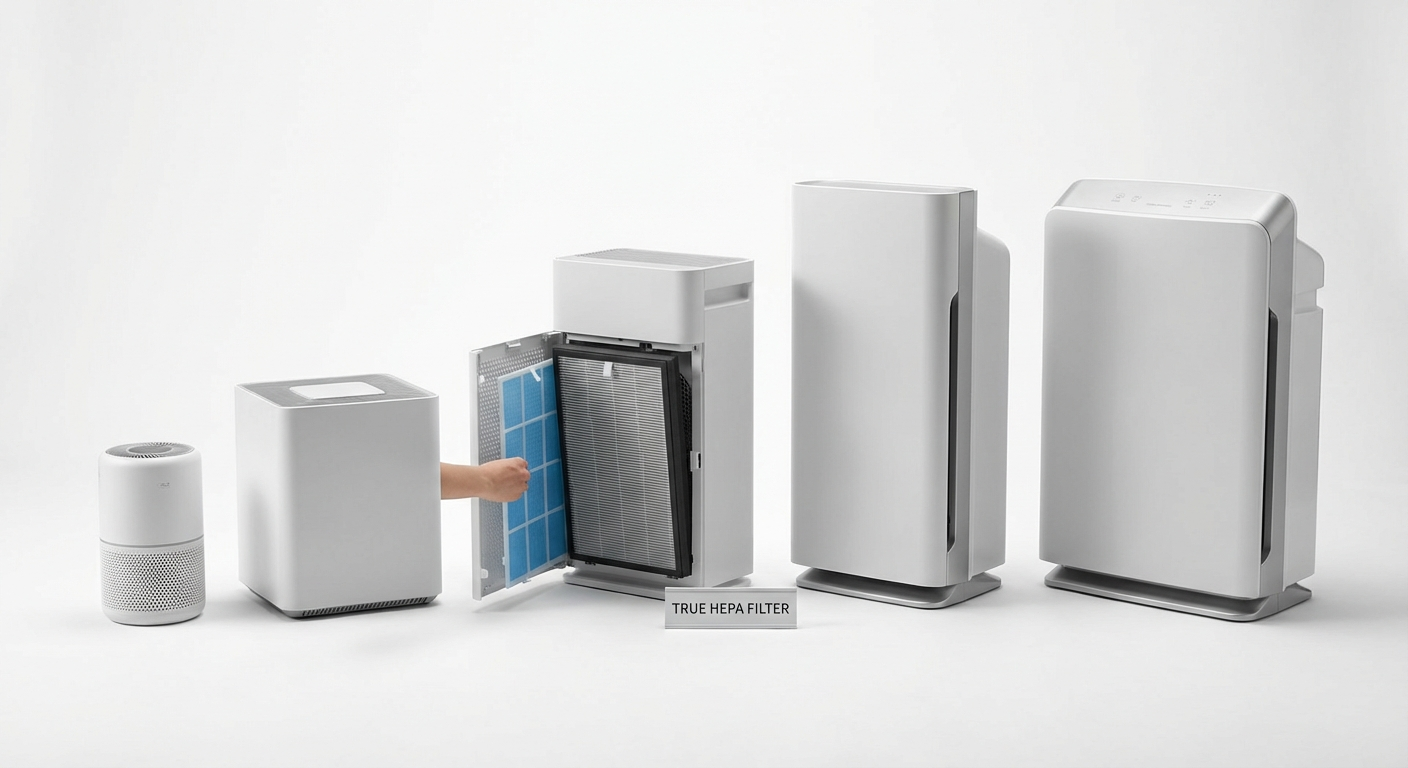
Asthma is driven by airborne triggers — dust mite allergens, pet dander, mold spores, pollen, and fine particulate matter that inflame already-sensitized airways. You can clean surfaces, wash bedding, and vacuum daily, but airborne particles resettle within minutes and become re-aerosolized with every movement through a room.
A HEPA air purifier addresses this gap by continuously removing airborne particulate triggers before you inhale them. The evidence is clear: peer-reviewed research published in respiratory and allergy journals has demonstrated that HEPA air purifiers reduce airborne allergen concentrations and, in some studies, reduce asthma symptom severity and medication use. The EPA recognizes portable air cleaners with HEPA filters as an effective strategy for reducing indoor particulate matter.
But not all air purifiers help asthma equally. Some produce ozone — a lung irritant that can trigger attacks. Some use "HEPA-type" filters that lack standardized performance. And many are drastically undersized for the rooms they claim to cover, delivering air changes so slow that trigger concentrations never meaningfully drop.
This guide evaluates 5 air purifiers specifically for asthma management using the metrics that respiratory health experts recommend: CADR, air changes per hour (ACH), HEPA filtration grade, and ozone safety.
Medical disclaimer: This guide provides evidence-based information about air purifiers for asthma trigger reduction. It is not medical advice. An air purifier does not treat or cure asthma. Continue all prescribed medications and follow your asthma action plan as directed by your healthcare provider. The Asthma and Allergy Foundation of America recommends air purifiers as part of an environmental control strategy, not as a replacement for medical treatment.
Why Air Purifiers Matter for Asthma
The Trigger Problem
Asthma attacks are typically triggered by inhaling irritants or allergens that cause airway inflammation and bronchospasm. The Mayo Clinic identifies common indoor asthma triggers as:
- Dust mite allergens (particles 10–40 microns — easily captured by HEPA)
- Pet dander (particles 2.5–10 microns)
- Mold spores (particles 1–20 microns)
- Pollen (particles 10–100 microns)
- Fine particulate matter (PM2.5) — from cooking, candles, outdoor pollution infiltration
- Tobacco and wildfire smoke (particles 0.1–1 micron)
All of these are particulate — meaning a True HEPA filter captures them with 99.97% efficiency. The challenge is not whether the filter works, but whether the purifier moves enough air through the filter fast enough to reduce room concentrations meaningfully. That is where CADR and ACH become critical.
What the Research Shows
Multiple studies have examined HEPA air purifier use for asthma patients:
- Research in the Journal of Allergy and Clinical Immunology demonstrated that bedroom HEPA air purifiers significantly reduced airborne dust mite and pet allergen concentrations in homes of asthmatic children.
- Studies funded by the EPA's Indoor Environments Division found that portable HEPA air cleaners reduced indoor PM2.5 concentrations by 25–45% in single rooms when run continuously.
- The Asthma and Allergy Foundation of America (AAFA) recommends HEPA air purifiers as part of a comprehensive allergen avoidance strategy, noting that air filtration is most effective when combined with source control (removing or reducing trigger sources).
The evidence supports HEPA air purifiers as a meaningful component of asthma management — not a miracle solution, but a tool that measurably reduces the airborne trigger load your airways face.
How We Evaluate: CADR, ACH, and What Actually Matters
CADR (Clean Air Delivery Rate)
CADR measures how many cubic feet of clean air a purifier delivers per minute. It is the most important single performance metric and should be independently verified by AHAM (Association of Home Appliance Manufacturers) where possible.
CADR is measured separately for three particle types:
- Smoke (0.09–1.0 microns) — the hardest to capture; the most relevant for fine particulate
- Dust (0.5–3.0 microns) — relevant for dust mite allergens
- Pollen (5.0–11.0 microns) — the easiest to capture
For asthma, the smoke CADR is the most important number because it represents performance against the smallest and hardest-to-capture particles. A purifier with a high pollen CADR but low smoke CADR may not adequately address fine particulate triggers.
ACH (Air Changes per Hour)
ACH tells you how many times per hour the purifier can filter the entire volume of air in a room. This is the metric that determines whether a purifier can maintain low trigger concentrations — not just clean the air once, but keep it clean continuously.
How to calculate ACH:
ACH = (CADR in CFM × 60) ÷ Room Volume in cubic feet
Room Volume = Length × Width × Ceiling Height (typically 8 ft)
Recommended ACH for asthma:
- 4 ACH — minimum for general air quality improvement
- 5 ACH — adequate for mild asthma or allergy management
- 6+ ACH — recommended for moderate-to-severe asthma by allergy specialists
Most manufacturer-stated "room size" coverage assumes only 2–3 ACH — far below the 6 ACH recommended for asthma. A purifier rated for "400 sq ft" may only deliver 6 ACH in a 200 sq ft room. Our reviews below include ACH calculations at different room sizes so you can match the purifier to your actual space.
Comparison Table: 5 Best Air Purifiers for Asthma
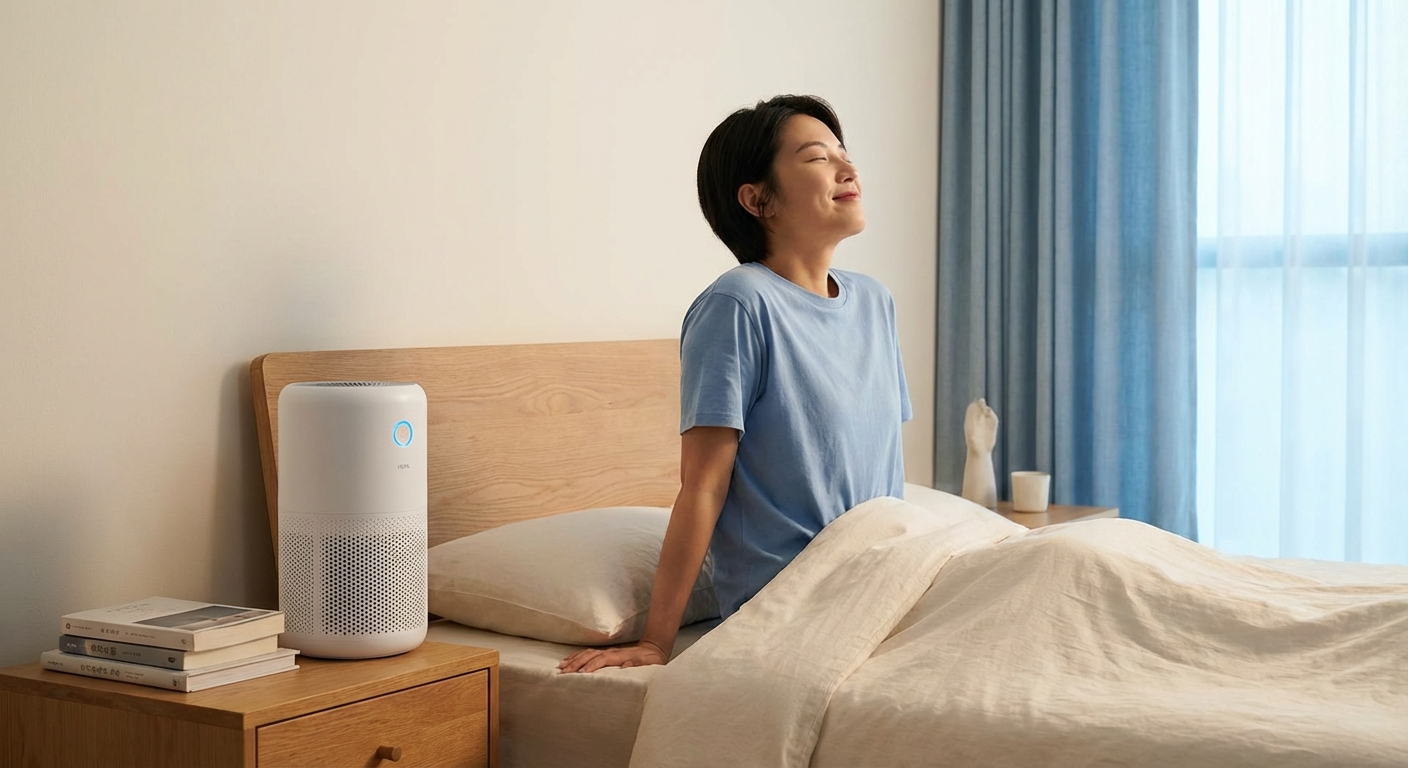
| Air Purifier | Filter Type | CADR (Smoke/Dust/Pollen) | Noise (Low/High) | Room Size (6 ACH) | Ozone-Free | Price | Best For |
|---|---|---|---|---|---|---|---|
| Coway AP-1512HH | True HEPA + Carbon | 233/246/240 CFM | 24/53 dB | ~165 sq ft | ✅ CARB certified | ~$150 | Best overall value |
| Levoit Core 400S | H13 HEPA + Carbon | 187/225/243 CFM | 24/52 dB | ~150 sq ft | ✅ Ozone-free | ~$230 | Best smart features |
| IQAir HealthPro Plus | HyperHEPA + Carbon | 300+/300+/300+ CFM | 22/59 dB | ~200 sq ft | ✅ No ionizer | ~$900 | Best for severe asthma |
| Dyson Pure Cool TP07 | HEPA + Carbon | 130/140/155 CFM | 30/62 dB | ~90 sq ft | ✅ No ionizer | ~$550 | Best air quality display |
| Blueair Blue Pure 211+ | HEPASilent + Carbon | 350/350/350 CFM | 31/56 dB | ~235 sq ft | ⚠️ Ionizer (disableable) | ~$300 | Best for large rooms |
Note on room sizes: The "Room Size (6 ACH)" column shows the maximum room size where each purifier achieves 6 air changes per hour — the threshold recommended for asthma. Manufacturer-stated room sizes are typically based on 2–3 ACH and will be substantially larger.
Detailed Reviews
1. Coway Airmega AP-1512HH — Best Overall Value
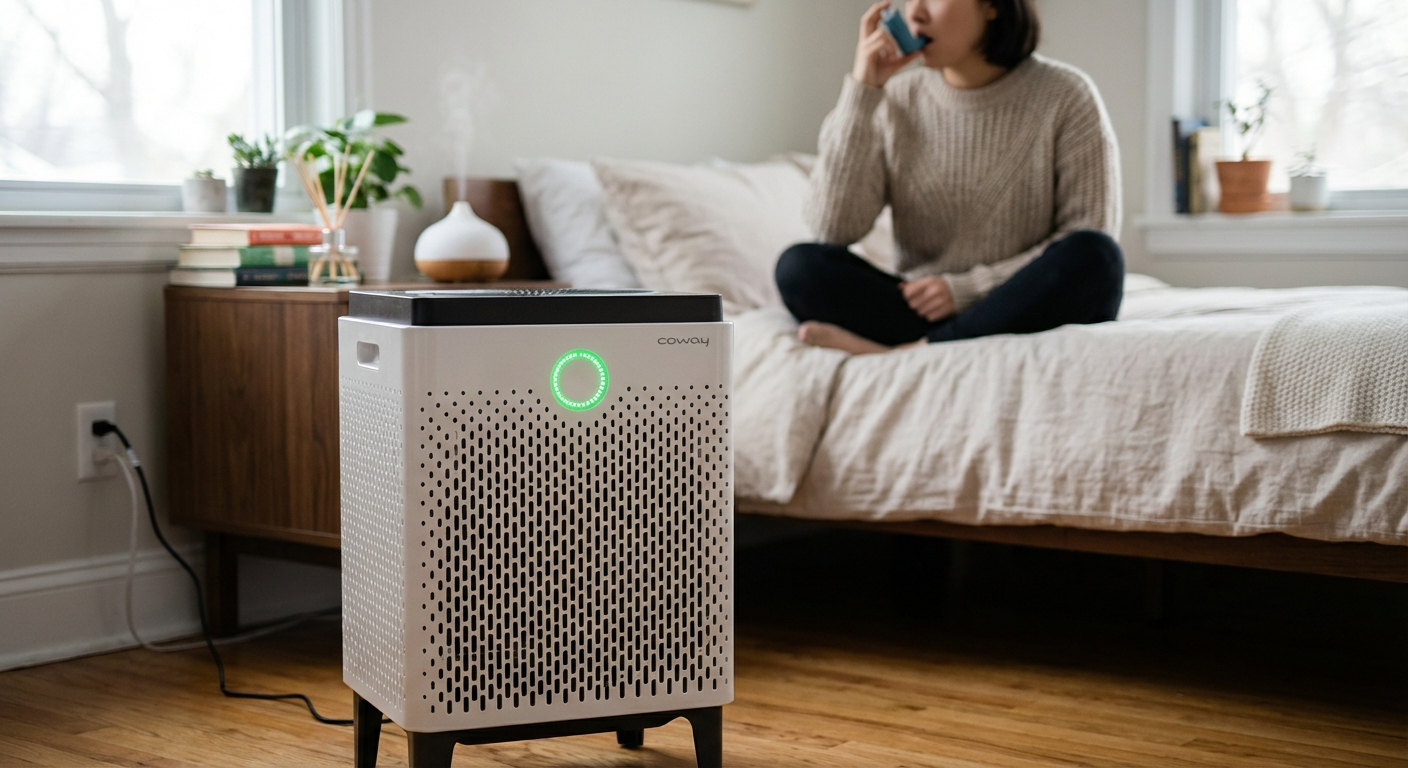
Why it wins for asthma: The AP-1512HH — widely known as the "Mighty" — delivers the best balance of CADR, noise, and price for asthma sufferers. At a smoke CADR of 233 CFM, it achieves 6 ACH in rooms up to approximately 165 sq ft (a typical bedroom). It is CARB certified with zero ozone emissions and uses a genuine True HEPA filter.
The Mighty has been independently tested and recommended by HouseFresh, Wirecutter, Consumer Reports, and numerous allergy-focused publications. It is not the newest or flashiest purifier, but it is among the most proven. The eco mode automatically reduces fan speed when air quality is good, dropping noise to 24 dB — quieter than a whisper.
ACH by room size:
| Room Size | ACH |
|---|---|
| 100 sq ft | 10.5 |
| 150 sq ft | 7.0 |
| 200 sq ft | 5.2 |
| 250 sq ft | 4.2 |
Pros:
- Excellent CADR-to-price ratio — best value on this list
- CARB certified, zero ozone, no ionizer
- Eco mode runs at 24 dB — bedroom-silent
- Filter replacement indicator built in
- Proven track record — years of independent testing validation
- Compact footprint (16.8" × 9.6" × 18")
Cons:
- No smart app connectivity — manual controls only
- Carbon filter is a thin pre-filter — limited VOC/odor removal
- Air quality sensor is basic compared to smart-featured competitors
- Plastic build feels less premium than the Dyson or IQAir
- Max fan speed (53 dB) is noticeable in quiet bedrooms
- Filter replacement cost (~$40–50/year) is moderate
Best for: Asthma sufferers who want strong HEPA performance in a bedroom or home office without overpaying. If you want the most scientifically validated air purifier at a reasonable price, this is it.
2. Levoit Core 400S — Best Smart Features
Why it is strong for asthma: The Core 400S combines H13 HEPA filtration with smart auto-mode that adjusts fan speed based on real-time air quality readings via its built-in laser particle sensor. For asthma sufferers, the auto-mode is particularly valuable — it ramps up when trigger concentrations spike (cooking, vacuuming, opening windows) and returns to near-silent operation when air is clean.
The VeSync app provides PM2.5 readings, filter life tracking, and scheduling — useful for monitoring the air quality your lungs are actually exposed to. The H13 HEPA filter captures 99.95% of particles at the most penetrating particle size, meeting the European medical-grade standard.
ACH by room size:
| Room Size | ACH |
|---|---|
| 100 sq ft | 8.4 |
| 150 sq ft | 5.6 |
| 200 sq ft | 4.2 |
| 300 sq ft | 2.8 |
Pros:
- H13 HEPA filtration — European medical-grade standard
- Smart auto-mode reacts to real-time air quality changes
- VeSync app with PM2.5 monitoring, filter tracking, scheduling
- Ozone-free — no ionizer component
- 360-degree air intake — effective placement flexibility
- Sleep mode at 24 dB with display off
Cons:
- Lower smoke CADR (187 CFM) than the Coway — needs a smaller room for 6 ACH
- Requires Wi-Fi for smart features (no manual air quality display without app)
- Filter replacement cost (~$45–55/year) is slightly higher than the Coway
- VeSync app collects usage data — privacy-conscious users may object
- Carbon filter component is adequate but not exceptional for VOCs
- Taller profile (20.5") may not fit under low shelving
Best for: Asthma sufferers who want data-driven monitoring of their indoor air quality and automatic trigger response. Ideal if you want to see PM2.5 numbers and set schedules for different times of day.
3. IQAir HealthPro Plus — Best for Severe Asthma
Why it is the premium choice: The HealthPro Plus is used in hospitals, dental offices, and clean rooms. Its HyperHEPA filter captures particles down to 0.003 microns — 100 times smaller than standard HEPA's 0.3-micron threshold. This means it captures ultrafine particles, some bacteria, and certain viruses that standard HEPA filters miss.
For severe asthma where ultrafine particulate triggers play a role, or for patients who are immunocompromised alongside their asthma, the HealthPro Plus represents the highest level of residential air filtration available. It uses no ionizer and produces zero ozone.
The price reflects the medical-grade positioning: ~$900 for the unit, with filters costing $100–200+ annually. This is a significant investment, but for patients whose asthma is poorly controlled despite standard environmental measures, the incremental filtration performance may be clinically meaningful.
ACH by room size:
| Room Size | ACH |
|---|---|
| 150 sq ft | 9.0 |
| 200 sq ft | 6.8 |
| 300 sq ft | 4.5 |
| 400 sq ft | 3.4 |
Pros:
- HyperHEPA filtration to 0.003 microns — nothing else in residential class matches this
- Used in medical and clinical settings — proven institutional trust
- No ionizer, zero ozone — safest possible for respiratory patients
- 3-stage filtration (pre-filter + carbon + HyperHEPA)
- Swiss-manufactured with rigorous quality control
- 10-year warranty on the unit (best-in-class)
Cons:
- Premium price (~$900) — 6x the cost of the Coway
- Filter replacement is expensive ($100–200+ annually)
- No smart features — manual controls, no app, no auto-mode
- Large and heavy (35 lbs, 28" tall) — not easily portable
- No air quality sensor — cannot react automatically to trigger spikes
- Dated industrial design compared to consumer-focused competitors
Best for: Severe asthma sufferers, immunocompromised patients, or anyone for whom standard HEPA has not provided sufficient symptom relief. This is the purifier a pulmonologist would use in their own home. If your asthma is mild-to-moderate and well-controlled, the Coway or Levoit delivers strong results at a fraction of the cost.
4. Dyson Pure Cool TP07 — Best Air Quality Display
Why it is relevant for asthma: The TP07 combines HEPA+carbon filtration with the best real-time air quality display on any residential purifier. The built-in LCD shows PM2.5, PM10, VOC, and NO2 levels — four separate pollutant categories, updated in real time. For asthma patients working to identify their specific triggers, this granular data is genuinely useful.
The TP07 also functions as a bladeless fan, providing cooling airflow in addition to purification. Auto-mode adjusts fan speed based on detected air quality, and the Dyson Link app provides historical air quality data and trends.
The tradeoff: the TP07's CADR is substantially lower than the Coway and Blueair, meaning it needs a smaller room to achieve adequate ACH for asthma. At a smoke CADR of approximately 130 CFM, it only reaches 6 ACH in rooms of about 90 sq ft — a small bedroom or home office.
ACH by room size:
| Room Size | ACH |
|---|---|
| 80 sq ft | 7.3 |
| 100 sq ft | 5.9 |
| 150 sq ft | 3.9 |
| 200 sq ft | 2.9 |
Pros:
- Best-in-class air quality display — PM2.5, PM10, VOC, NO2 readings
- Historical air quality data via Dyson Link app
- Dual function as air purifier + bladeless fan
- Fully sealed filtration system — no air bypasses the filter
- Auto-mode reacts to real-time air quality changes
- Night mode dims display and reduces airflow noise
Cons:
- Lowest CADR on this list — only achieves 6 ACH in ~90 sq ft
- Most expensive non-medical option (~$550) with moderate filtration performance
- Filter replacement is costly (~$70–80/year)
- Fan function blows purified air directly — may cause discomfort for cold-sensitive asthmatics
- CADR is not AHAM-certified — Dyson does not participate in AHAM Verifide program
- Premium price is largely for the display, design, and fan function — not for filtration performance
Best for: Asthma sufferers who want to actively monitor and understand their indoor air quality, and who value the dual fan function. Best in a small bedroom or office where its CADR can achieve adequate ACH. Not recommended as a primary purifier for rooms over 120 sq ft.
5. Blueair Blue Pure 211+ — Best for Large Rooms
Why it matters for asthma: The Blue Pure 211+ has the highest CADR on this list at 350 CFM across all three particle categories, making it the best option for asthma sufferers who need to purify larger living spaces — open-plan living rooms, combined kitchen-living areas, or master suites. It achieves 6 ACH in rooms up to approximately 235 sq ft.
Blueair's HEPASilent technology combines mechanical HEPA filtration with electrostatic charging to capture particles with less airflow resistance. This means the 211+ can deliver high CADR at lower fan speeds and noise levels than competitors with equivalent output — a meaningful advantage for continuous 24/7 operation.
Important note: The 211+ includes an ionizer component as part of HEPASilent technology. The ionizer can be disabled for asthma sufferers who prefer zero ionization. When disabled, CADR drops slightly but remains strong. CARB certification status should be verified before purchase.
ACH by room size:
| Room Size | ACH |
|---|---|
| 150 sq ft | 10.5 |
| 200 sq ft | 7.9 |
| 250 sq ft | 6.3 |
| 350 sq ft | 4.5 |
Pros:
- Highest CADR on this list (350 CFM) — best for large rooms
- HEPASilent delivers high output at lower noise than pure mechanical HEPA
- Low energy consumption (~30W on medium) — efficient for 24/7 operation
- Simple one-button control — no complex interface
- Washable pre-filter (fabric sleeve) reduces ongoing costs
- Quiet enough for living room use (31 dB on low, 56 dB on high)
Cons:
- Ionizer component — disableable, but concerning for ozone-sensitive asthmatics
- No smart features — no app, no auto-mode, no air quality sensor
- Large footprint (13" × 13" × 20") — not compact
- Filter replacement is moderately expensive (~$40–60/year)
- No display — no visible air quality feedback
- Fabric pre-filter sleeve shows dirt and requires periodic washing
Best for: Asthma sufferers who need to cover a larger room (200+ sq ft) and want quiet, high-CADR performance. Disable the ionizer and pair with a standalone air quality monitor for the best asthma-focused setup. For smaller rooms, the Coway delivers similar per-area performance at half the price.
Understanding HEPA Grades for Asthma
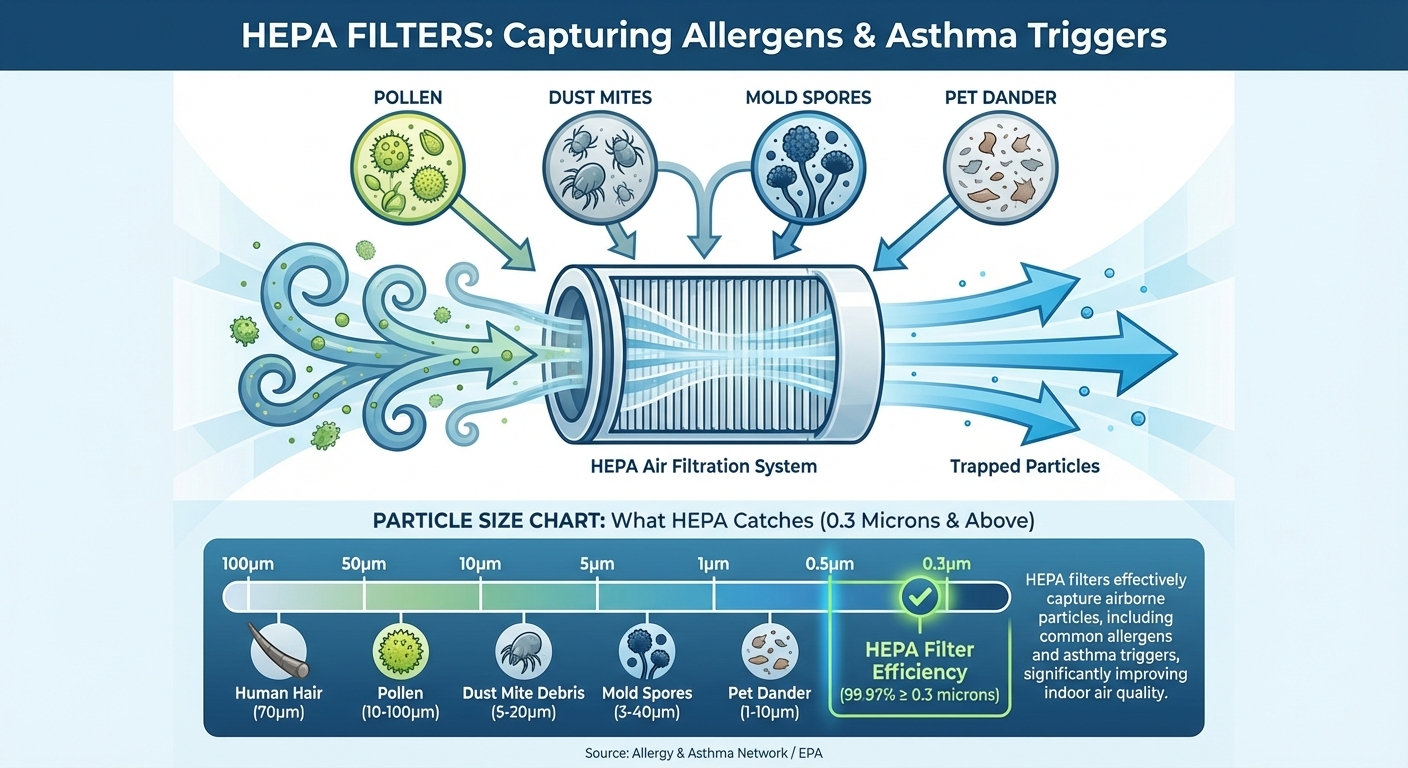
Not all "HEPA" claims are equal. Here is what the labels actually mean:
| Label | Standard | Captures | Asthma Suitability |
|---|---|---|---|
| True HEPA | US DOE standard | ≥99.97% of particles at 0.3 microns | ✅ Recommended minimum |
| H13 HEPA | EN 1822 (European) | ≥99.95% at MPPS (most penetrating particle size) | ✅ Equivalent to True HEPA |
| H14 HEPA | EN 1822 (European) | ≥99.995% at MPPS | ✅ Superior — used in cleanrooms |
| HyperHEPA | IQAir proprietary | ≥99.5% at 0.003 microns | ✅ Best available residential |
| HEPA-type / HEPA-style | No standard | Unknown — could be 80%, could be 95% | ❌ Avoid for asthma |
| HEPA-like | No standard | Unknown | ❌ Avoid for asthma |
The critical distinction: True HEPA and H13 HEPA are tested and certified to specific performance thresholds. "HEPA-type" and "HEPA-style" are marketing terms with no regulatory definition. A "HEPA-type" filter might capture 85% of particles — significantly less than the 99.97% a True HEPA achieves. For asthma sufferers, this 15% gap is the difference between meaningful trigger reduction and inadequate filtration.
Ozone and Ionizer Safety
Ozone (O₃) is a potent respiratory irritant. The EPA and the Asthma and Allergy Foundation of America both warn that ozone can trigger asthma attacks, reduce lung function, and cause chest pain even at concentrations below federal limits.
Which Purifiers Produce Ozone?
- Ionizers (also called ionic purifiers) produce ozone as a byproduct of electrically charging airborne particles
- UV-C purifiers can produce ozone when UV light interacts with oxygen
- Plasma and photocatalytic oxidation (PCO) purifiers produce ozone as part of their purification mechanism
- HEPA-only purifiers do not produce ozone — they use mechanical filtration exclusively
What to Look For
- CARB certification: The California Air Resources Board certifies that a device produces less than 0.05 ppm ozone — the threshold considered safe for continuous exposure. The Coway AP-1512HH is CARB certified.
- "Ozone-free" labeling: The Levoit Core 400S and Levoit product line are marketed as ozone-free with no ionizer component.
- Disableable ionizer: The Blueair 211+ includes an ionizer that can be turned off. For asthma sufferers, disable it and rely on the mechanical HEPA filtration alone.
- No ionizer: The IQAir HealthPro Plus and Dyson TP07 contain no ionizer component.
Our recommendation for asthma: Choose a purifier with no ionizer. If the best-performing purifier for your room size includes an ionizer, ensure it can be disabled permanently. Do not rely on CARB certification alone — even sub-0.05 ppm ozone exposure may irritate highly sensitive airways.
Room Size and ACH Calculations
Manufacturer-stated room sizes are misleading for asthma sufferers because they typically assume 2–3 ACH. Here is how to calculate the ACH you will actually get:
ACH Formula
ACH = (CADR in CFM × 60) ÷ (Room Length ft × Room Width ft × Ceiling Height ft)```

> **Real-world note:** Manufacturer CADR ratings are measured in ideal lab conditions. In real rooms, furniture, placement distance from walls, and airflow obstacles typically reduce effective CADR by 30–40%. Our product ACH tables use a 60% efficiency factor (conservative) to reflect actual bedroom performance. When calculating your own ACH, apply this same 0.6 multiplier to the stated CADR for realistic estimates.


### Example Calculation

**Room:** 12 ft × 15 ft bedroom with 8 ft ceiling = 1,440 cubic feet
**Purifier:** Coway AP-1512HH with smoke CADR of 233 CFM
ACH = (233 × 0.6 × 60) ÷ 1,440 = 8,388 ÷ 1,440 = 5.8 ACH
After applying the 0.6 real-world derating factor, this bedroom would get approximately 5.8 ACH — just below the 6 ACH threshold for asthma. To reliably exceed 6 ACH, use the Coway in a room under 150 sq ft, or step up to the IQAir HealthPro Plus for larger bedrooms.

### Quick Reference: Room Size for 6 ACH

| Purifier | Smoke CADR | Max Room Size at 6 ACH (8 ft ceiling) |
|----------|:---------:|:-------------------------------------:|
| Blueair 211+ | 350 CFM | ~235 sq ft |
| IQAir HealthPro Plus | 300 CFM | ~200 sq ft |
| Coway AP-1512HH | 233 CFM | ~155 sq ft |
| Levoit Core 400S | 187 CFM | ~125 sq ft |
| Dyson TP07 | 130 CFM | ~87 sq ft |

**Takeaway:** Buy for the room you will actually use the purifier in, not for the manufacturer's stated coverage. For asthma, 6 ACH in your bedroom is worth more than 3 ACH in your living room — you spend 7–8 hours breathing bedroom air while sleeping, when your airways are most vulnerable.

---

## Total Cost of Ownership

An air purifier's purchase price is only part of the cost. Running 24/7 means ongoing filter replacements and electricity. Here is the 3-year TCO for each pick:

| Purifier | Purchase Price | Annual Filter Cost | Annual Electricity (~24/7 medium) | 3-Year TCO |
|----------|:-------------:|:-----------------:|:--------------------------------:|:----------:|
| **Coway AP-1512HH** | $150 | ~$45 | ~$25 | **$360** |
| **Levoit Core 400S** | $230 | ~$50 | ~$20 | **$440** |
| **Blueair 211+** | $300 | ~$50 | ~$15 | **$495** |
| **Dyson TP07** | $550 | ~$75 | ~$30 | **$865** |
| **IQAir HealthPro Plus** | $900 | ~$150 | ~$35 | **$1,455** |

The Coway is the clear value winner at $360 over 3 years. The IQAir costs 4x more over the same period — a premium justified only by its superior filtration for severe cases. For most asthma sufferers, the Coway or Levoit delivers excellent results at a manageable ongoing cost.

---

## Frequently Asked Questions

### Do air purifiers actually help with asthma?
Yes — peer-reviewed research demonstrates that HEPA air purifiers reduce airborne asthma triggers including dust mite allergens, pet dander, mold spores, and fine particulate matter. The EPA notes that portable air cleaners with HEPA filters can reduce indoor particulate concentrations. The most benefit comes from running the purifier continuously in the room where you spend the most time, particularly the bedroom. An air purifier is one component of an asthma management plan, not a replacement for medication.

### What HEPA grade is best for asthma?
True HEPA (US standard) or H13 HEPA (European standard) is the minimum recommended grade for asthma sufferers. Both capture at least 99.95–99.97% of particles at 0.3 microns — the most penetrating particle size. Avoid products labeled "HEPA-type" or "HEPA-style," which have no standardized performance requirement. For severe asthma, HyperHEPA filtration (IQAir) captures particles down to 0.003 microns, including ultrafine particles.

### Are ionizers safe for people with asthma?
Most pulmonologists and the Asthma and Allergy Foundation of America recommend avoiding ionizers for asthma sufferers. Ionizers produce ozone as a byproduct, and ozone is a known respiratory irritant that can trigger asthma attacks even at low concentrations. If a purifier includes an ionizer, ensure it can be permanently disabled. Look for CARB (California Air Resources Board) certification, which limits ozone output to 0.05 ppm or less.

### What is ACH and why does it matter for asthma?
ACH (Air Changes per Hour) measures how many times an air purifier can filter the entire volume of air in a room per hour. For general air quality improvement, 4 ACH is adequate. For asthma and allergy sufferers, 6+ ACH is recommended — this means the purifier filters all the air in the room at least 6 times every hour. Higher ACH means airborne triggers are removed faster after they become airborne. See our ACH calculation section above for how to determine the right purifier for your room.

### Should I run my air purifier 24/7 for asthma?
Yes. Asthma triggers become airborne continuously — from movement, HVAC systems, opening doors, and normal household activity. Turning off the purifier allows trigger concentrations to rebuild within 30–60 minutes. Run the purifier on a low or auto setting continuously, especially in the bedroom during sleep when airways are most vulnerable. Choose an Energy Star certified model to minimize electricity costs from 24/7 operation.

### Do HEPA air purifiers remove all asthma triggers?
HEPA filters effectively remove particulate triggers: dust mite allergens, pet dander, mold spores, pollen, and fine particulate matter (PM2.5). They do not remove gaseous triggers: volatile organic compounds (VOCs), nitrogen dioxide, formaldehyde, or strong odors. For gaseous triggers, choose a purifier with both a HEPA filter and a substantial activated carbon filter. Thin carbon pre-filters are minimally effective — look for pelleted or granular carbon beds weighing at least 1–2 lbs. For mold-specific air quality concerns, see our [best air purifier for mold guide](/best-air-purifier-mold).

### How much should I spend on an air purifier for asthma?
An effective HEPA air purifier for asthma costs $100–250 for a single room (up to 400 sq ft). The Coway AP-1512HH (~$150) and Levoit Core 400S (~$230) deliver strong CADR and True HEPA filtration in this range. Premium medical-grade options like the IQAir HealthPro Plus cost $900+. Factor in annual filter replacement costs ($30–100/year for mid-range, $100–200/year for premium) when budgeting.

### Can an air purifier replace asthma medication?
No. An air purifier reduces airborne triggers, which may reduce symptom frequency and severity, but it does not treat the underlying airway inflammation that defines asthma. Continue all prescribed medications and follow your asthma action plan. The Asthma and Allergy Foundation of America recommends air purifiers as part of an environmental control strategy alongside — not instead of — medical treatment. For baby and nursery setups, see our [best air purifier for baby room guide](/best-air-purifier-baby-room).

---

## Sources & Methodology

This guide evaluates air purifiers for asthma using four primary criteria: CADR (with emphasis on smoke CADR as the most relevant metric for fine particulate triggers), ACH achievable at 6 air changes per hour (the threshold recommended by allergy specialists for asthma), HEPA filtration grade, and ozone/ionizer safety.

**Medical and Scientific References:**
- Asthma and Allergy Foundation of America: Indoor Air Quality and Asthma — [aafa.org](https://aafa.org/)
- EPA: Indoor Air Quality and Portable Air Cleaners — [epa.gov/indoor-air-quality-iaq](https://www.epa.gov/indoor-air-quality-iaq)
- Mayo Clinic: Asthma Triggers — [mayoclinic.org](https://www.mayoclinic.org/)
- NIOSH: Indoor Environmental Quality — [cdc.gov/niosh](https://www.cdc.gov/niosh/)
- Journal of Allergy and Clinical Immunology: studies on HEPA filtration and allergen reduction in homes of asthmatic patients
- EPA Indoor Environments Division: research on portable HEPA air cleaner effectiveness for PM2.5 reduction

**Technical and Certification References:**
- AHAM (Association of Home Appliance Manufacturers): CADR testing methodology and Verifide program — [aham.org](https://www.aham.org/)
- CARB (California Air Resources Board): Ozone emission limits for indoor air cleaning devices — [arb.ca.gov](https://ww2.arb.ca.gov/)
- Energy Star: Air Purifier Certification Criteria — [energystar.gov](https://www.energystar.gov/)
- EN 1822: European HEPA filter classification standard (H13/H14 grades)

**Methodology notes:**
- CADR figures are sourced from AHAM-certified data where available; for products not participating in AHAM Verifide (Dyson, IQAir), manufacturer specifications are used and noted accordingly
- ACH calculations use smoke CADR (the most conservative and asthma-relevant metric) and assume standard 8-foot ceiling height
- Room size recommendations at 6 ACH are calculated directly from CADR data, not from manufacturer-stated room coverage
- Noise levels in dB are from manufacturer specifications measured at 1 meter distance
- Price and filter cost data reflects typical US retail pricing at time of publication and may fluctuate
- We link to Amazon search results to ensure links remain functional; we may earn a commission on purchases at no additional cost to you; affiliate relationships do not influence our recommendations or scores
- This guide is not medical advice; consult your healthcare provider for asthma management decisions