Guide
How Much Does It Cost to Run an Air Purifier? (Full Breakdown 2026)
By Dr. Alex Chen · Updated 2026-03-17
Running an air purifier costs most households between $3 and $12 per month in electricity, depending on the model, fan speed, and how many hours per day it operates. At the 2026 US national average electricity rate of $0.16/kWh, a mid-range HEPA air purifier used for 8 hours daily adds roughly $1.
Quick Facts
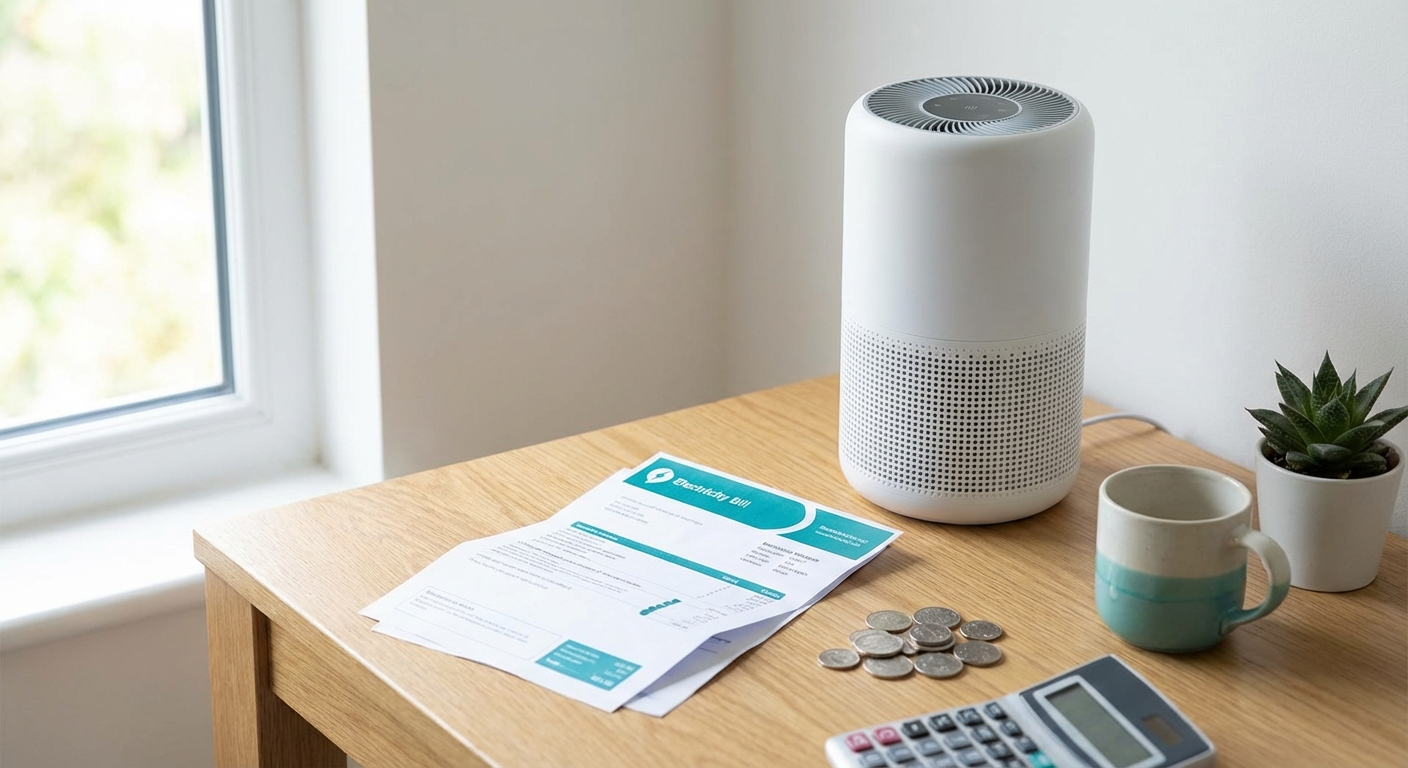
💡 Most air purifiers cost $3–$12/month to run
Running 8 hours daily at average US electricity rates — less than a cup of coffee per week
If you have been putting off buying an air purifier because you are worried about ongoing electricity costs, you are not alone. It is one of the most common concerns we hear from readers. The good news is that modern air purifiers are remarkably energy-efficient, and the real cost of ownership might surprise you.
In this guide, we break down exactly how much it costs to run the most popular air purifiers on the market in 2026, explain the simple formula you can use to calculate costs for any model, and share practical tips for keeping your electricity bill as low as possible.
Understanding Air Purifier Energy Consumption
Before we dive into specific numbers, it helps to understand what drives energy consumption in an air purifier. Three primary factors determine how much electricity your unit draws:
Wattage Rating
Every air purifier has a wattage rating, typically printed on the unit or listed in the product specifications. This number tells you how much power the unit draws at maximum capacity. Most residential air purifiers range from 20 watts on the low end to 200 watts for large-room commercial-grade models.
However, the maximum wattage is rarely what you will actually use. Most people run their purifiers on medium or auto settings, which draw significantly less power than the highest fan speed.
Daily Usage Hours
How long you run your air purifier each day is the single biggest variable in your electricity costs. Some people run theirs only at night (6–8 hours), while others keep it running around the clock (24 hours). For this guide, we use 8 hours per day as our baseline — a common scenario for bedroom use during sleeping hours.
If you suffer from allergies or live in an area with poor outdoor air quality, you might run your unit for longer periods. We will show you how to calculate costs for any usage scenario later in this article.
Fan Speed Setting
Most air purifiers offer three to five fan speed settings plus an auto mode. The difference in power draw between the lowest and highest settings can be dramatic. For example, the Levoit Core 300S draws just 15 watts on its lowest setting but 45 watts on its highest — a threefold difference that directly affects your electricity bill.
Auto mode is often the most cost-effective choice, as the purifier ramps up only when it detects a dip in air quality and otherwise runs at a quieter, lower-power setting. If you are concerned about noise levels, running on a lower speed setting has the added benefit of keeping things whisper-quiet.
The Simple Formula for Calculating Air Purifier Electricity Costs
You do not need a degree in electrical engineering to work out your running costs. Here is the straightforward formula:
Step-by-Step kWh Calculation
Daily Cost = (Wattage × Hours Used per Day ÷ 1,000) × Electricity Rate
Let us break this down with a real example using the Levoit Core 300S at its highest setting:
- Identify the wattage: 45 watts
- Determine daily hours of use: 8 hours
- Convert to kilowatt-hours (kWh): 45W × 8h ÷ 1,000 = 0.36 kWh
- Multiply by your electricity rate: 0.36 kWh × $0.16/kWh = $0.058 per day
- Calculate monthly cost: $0.058 × 30 = $1.73 per month
- Calculate annual cost: $0.058 × 365 = $21.02 per year
That is less than the cost of a single cup of coffee per month for cleaner indoor air.
Finding Your Local Electricity Rate
The US national average is approximately $0.16 per kWh in 2026, but rates vary significantly by state:
- Cheapest states: Louisiana ($0.10/kWh), Oklahoma ($0.11/kWh), Idaho ($0.11/kWh)
- Most expensive states: Hawaii ($0.43/kWh), Connecticut ($0.27/kWh), Massachusetts ($0.26/kWh)
- National average: $0.16/kWh
You can find your exact rate on your most recent electricity bill, typically listed as a per-kWh charge. For the calculations in this article, we use the national average of $0.16/kWh.
Cost Comparison: Popular Air Purifier Models (2026)
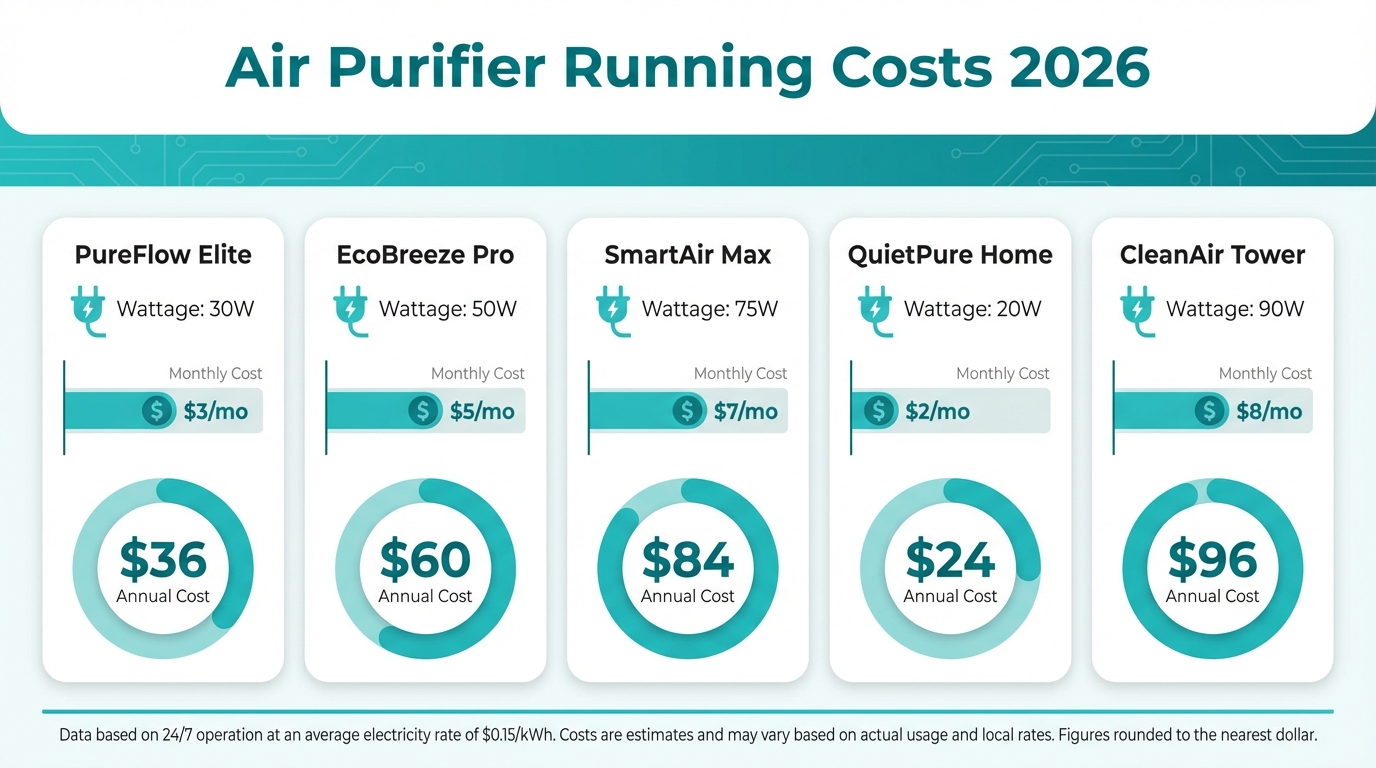
Here is what it actually costs to run the five most popular air purifiers in 2026. All calculations assume 8 hours of daily use at the highest fan speed and the US average electricity rate of $0.16/kWh.
| Model | Max Wattage | Daily kWh (8hrs) | Daily Cost | Monthly Cost | Annual Cost |
|---|---|---|---|---|---|
| Levoit Core 300S | 45W | 0.36 kWh | $0.06 | $1.73 | $21.02 |
| Coway AP-1512HH | 77W | 0.62 kWh | $0.10 | $2.96 | $35.98 |
| Winix 5500-2 | 70W | 0.56 kWh | $0.09 | $2.69 | $32.70 |
| Dyson TP09 | 40W | 0.32 kWh | $0.05 | $1.54 | $18.69 |
| Blueair 211+ | 61W | 0.49 kWh | $0.08 | $2.35 | $28.55 |
A few things stand out from this comparison. First, even the most power-hungry model on this list — the Coway AP-1512HH — costs less than $3 per month to operate for 8 hours a day. Second, the Dyson TP09 is surprisingly efficient despite its premium price tag, largely because it uses a brushless DC motor.
What About Running 24/7?
Many air quality experts recommend running your purifier continuously for the best results, especially if you have respiratory conditions. Here is what 24/7 operation looks like:
| Model | Daily kWh (24hrs) | Monthly Cost (24/7) | Annual Cost (24/7) |
|---|---|---|---|
| Levoit Core 300S | 1.08 kWh | $5.18 | $63.07 |
| Coway AP-1512HH | 1.85 kWh | $8.88 | $107.95 |
| Winix 5500-2 | 1.68 kWh | $8.06 | $98.11 |
| Dyson TP09 | 0.96 kWh | $4.61 | $56.06 |
| Blueair 211+ | 1.46 kWh | $7.04 | $85.64 |
Even at 24/7 operation on the highest setting, no model on this list exceeds $10 per month. In practice, running on auto mode or medium settings would cut these figures by 40–60%.
Model-by-Model Breakdown
Levoit Core 300S
The Levoit Core 300S remains one of the best-value air purifiers on the market in 2026. With a maximum draw of just 45 watts and smart auto mode that throttles down to 15 watts when air quality is good, it is exceptionally cheap to run.
- Low speed: 15W → $0.58/month (8hrs/day)
- Medium speed: 26W → $1.00/month (8hrs/day)
- High speed: 45W → $1.73/month (8hrs/day)
- Auto mode (estimated average): ~20W → $0.77/month (8hrs/day)
Replacement HEPA filters cost approximately $25–$35 and last 6–8 months, making the total annual cost of ownership around $60–$90 including electricity.
Coway AP-1512HH (Mighty)
The Coway AP-1512HH Mighty is a workhorse that handles rooms up to 361 square feet. It draws more power than the Levoit but covers a larger area, so the cost-per-square-foot is actually competitive.
- Low speed: 25W → $0.96/month (8hrs/day)
- Medium speed: 46W → $1.77/month (8hrs/day)
- High speed: 77W → $2.96/month (8hrs/day)
- Eco mode: ~4W → $0.15/month (8hrs/day)
The Coway's Eco mode is particularly noteworthy — when the unit detects clean air for 30 minutes, it shuts off the fan entirely and runs only the air quality sensor, drawing a minuscule 4 watts. Replacement filters run $30–$45 and last roughly 12 months.
Winix 5500-2
The Winix 5500-2 features PlasmaWave technology alongside its true HEPA filter. At 70 watts maximum, it sits in the middle of our comparison group.
- Low speed: 18W → $0.69/month (8hrs/day)
- Medium speed: 38W → $1.46/month (8hrs/day)
- High speed: 70W → $2.69/month (8hrs/day)
- Auto mode (estimated average): ~28W → $1.08/month (8hrs/day)
Replacement filters cost $40–$55 and are recommended every 12 months. The activated carbon filter needs replacing more frequently — every 3 months — at roughly $15 per filter, which adds to the overall ownership cost.
Dyson TP09 (Pure Cool Formaldehyde)
The Dyson TP09 doubles as a fan and air purifier, which can offset costs if it replaces a separate fan. Its efficient motor keeps power consumption impressively low at just 40 watts maximum.
- Low speed (1–3): 6–10W → $0.23–$0.38/month (8hrs/day)
- Medium speed (4–6): 15–25W → $0.58–$0.96/month (8hrs/day)
- High speed (7–10): 30–40W → $1.15–$1.54/month (8hrs/day)
- Auto mode (estimated average): ~15W → $0.58/month (8hrs/day)
The trade-off with Dyson is the filter cost. Replacement HEPA and carbon filters run $65–$80, and Dyson recommends replacing them every 12 months. The catalytic filter for formaldehyde, however, never needs replacing.
Blueair 211+
The Blueair 211+ is a favourite for large rooms up to 540 square feet. Its HEPASilent technology combines electrostatic and mechanical filtration, allowing it to use less dense filters and a less powerful fan while maintaining excellent filtration.
- Low speed: 20W → $0.77/month (8hrs/day)
- Medium speed: 38W → $1.46/month (8hrs/day)
- High speed: 61W → $2.35/month (8hrs/day)
Replacement filters cost $30–$40 every 6 months, putting total annual cost of ownership at roughly $90–$110 including electricity. For the room coverage it provides, this is excellent value.
Total Cost of Ownership: Electricity + Filters
Electricity is only part of the picture. Filter replacement is typically the larger ongoing expense. Here is what total annual ownership looks like for each model, assuming 8 hours of daily use on the highest setting:
| Model | Annual Electricity | Annual Filter Cost | Total Annual Cost |
|---|---|---|---|
| Levoit Core 300S | $21.02 | $40–$55 | $61–$76 |
| Coway AP-1512HH | $35.98 | $30–$45 | $66–$81 |
| Winix 5500-2 | $32.70 | $85–$115 | $118–$148 |
| Dyson TP09 | $18.69 | $65–$80 | $84–$99 |
| Blueair 211+ | $28.55 | $60–$80 | $89–$109 |
The Levoit Core 300S and Coway AP-1512HH lead the pack for total cost of ownership. The Winix 5500-2 is the most expensive to maintain primarily due to its separate carbon pre-filter that needs quarterly replacement.
8 Practical Tips to Reduce Air Purifier Running Costs
You do not have to sacrifice air quality to save money. These strategies can meaningfully reduce your electricity bill without compromising the clean air you breathe.
1. Use Auto Mode Whenever Possible
Auto mode adjusts fan speed based on real-time air quality readings. When the air is clean, the purifier drops to its lowest — and most energy-efficient — setting. This alone can cut electricity costs by 40–60% compared to running on high continuously.
2. Right-Size Your Purifier for the Room
An oversized purifier in a small room wastes energy. Conversely, an undersized unit in a large room has to work harder and run longer to clean the air. Match your purifier's recommended room size to the actual space you are using it in. Check our guide on air purifiers for large rooms if you need coverage for bigger spaces.
3. Keep Doors and Windows Closed
Every time you open a window, you introduce new pollutants that your purifier has to work to remove. Keeping the room sealed while the purifier runs means the air gets clean faster and stays clean longer, allowing the unit to operate at lower power settings.
4. Maintain Your Filters on Schedule
A clogged or dirty filter forces the fan motor to work harder, drawing more electricity. Replace HEPA filters according to the manufacturer's schedule, and vacuum pre-filters monthly. Clean filters also mean better air quality — it is a win on both fronts.
5. Position Your Purifier Strategically
Place your air purifier in the centre of the room or at least a foot away from walls and furniture. Blocked airflow forces the motor to work harder. Good placement means better air circulation and lower energy consumption.
6. Choose Energy Star Certified Models
Energy Star certified air purifiers are independently verified to be 25% more energy-efficient than standard models. Look for the Energy Star label when shopping — the Coway AP-1512HH and Winix 5500-2 both carry this certification.
7. Use a Smart Plug or Timer
If your air purifier does not have a built-in timer, a smart plug lets you schedule operation for specific hours. Running your purifier only during sleeping hours (8 hours) rather than 24/7 cuts electricity costs by two-thirds.
8. Clean Your Pre-Filter Regularly
Many air purifiers have a washable pre-filter that captures large particles before they reach the HEPA filter. Cleaning this every 2–4 weeks keeps airflow unobstructed and reduces strain on the motor. It also extends the life of your HEPA filter, saving you money on replacements.
Air Purifiers Compared to Other Household Appliances
To put air purifier costs in perspective, here is how they compare to other common household appliances:
| Appliance | Typical Wattage | Monthly Cost (8hrs/day) |
|---|---|---|
| Air purifier (mid-range) | 40–70W | $1.50–$2.70 |
| Ceiling fan | 50–75W | $1.90–$2.90 |
| Laptop computer | 50–65W | $1.90–$2.50 |
| LED television (55-inch) | 80–120W | $3.10–$4.60 |
| Space heater | 750–1,500W | $28.80–$57.60 |
| Window air conditioner | 500–1,400W | $19.20–$53.80 |
As you can see, an air purifier costs about the same to run as a ceiling fan and dramatically less than heating or cooling appliances. It is one of the most energy-efficient improvements you can make to your home environment.
Do Different Filter Types Affect Electricity Costs?
The type of filtration technology used in your air purifier does influence power consumption, though perhaps not as much as you might expect.
True HEPA Filters
True HEPA air purifiers use a dense filter medium that requires a stronger fan to push air through. This is why HEPA models typically draw 30–100 watts. However, advances in motor technology and filter design have made modern HEPA purifiers remarkably efficient. They remain the gold standard for particle removal, capturing 99.97% of particles as small as 0.3 microns.
Ionic and Electrostatic Purifiers
Ionisers and electrostatic purifiers use electrically charged plates or ions to capture particles. Because they do not need to force air through a dense filter, they typically draw just 5–30 watts. However, their cleaning effectiveness is generally lower than HEPA models, and some produce trace amounts of ozone as a byproduct — something worth considering alongside the modest electricity savings.
UV-C and Photocatalytic Purifiers
Models that include UV-C germicidal lamps add 5–15 watts to the total power draw. This is a minimal increase, and the added benefit of neutralising airborne pathogens can be worthwhile in certain situations. The UV-C bulbs themselves need replacing every 12–18 months at a cost of $15–$30.
Carbon Filters for Odours and VOCs
Activated carbon filters are used to capture volatile organic compounds (VOCs), odours, and gaseous pollutants. They do not directly affect electricity consumption — the power draw is determined by the fan motor, not the filter material. However, carbon filters that are saturated and overdue for replacement can restrict airflow, indirectly increasing energy use.
Frequently Asked Questions
How much electricity does an air purifier use per day?
Most home air purifiers use between 0.2 kWh and 0.8 kWh per day when run for 8 hours. A typical mid-range model like the Levoit Core 300S uses around 0.36 kWh per day on its highest setting, costing roughly $0.05 per day at the US average electricity rate of $0.16 per kWh. On auto mode, daily consumption drops to approximately 0.16 kWh, or about $0.03 per day. These figures make air purifiers one of the most energy-efficient appliances in the average home.
Is it expensive to run an air purifier 24/7?
Running an air purifier 24/7 is surprisingly affordable for most models. An energy-efficient unit like the Levoit Core 300S costs approximately $5.18 per month running continuously on high, or around $2.30 per month on auto mode. Higher-powered units like the Coway AP-1512HH may cost $8 to $9 per month at continuous high-speed operation. Using auto mode or lower fan speeds can reduce these costs by 40–60%. For people with allergies, asthma, or other respiratory conditions, the health benefits of continuous operation far outweigh the modest electricity expense.
Do air purifiers use more electricity than fans?
Air purifiers generally use similar or slightly more electricity than standard fans. A typical HEPA air purifier draws 30 to 100 watts, while a standard pedestal fan draws 25 to 75 watts and a ceiling fan draws 50 to 75 watts. The difference in electricity cost is usually less than $2 per month. Some air purifiers, like the Dyson TP09, double as fans, meaning you can replace two appliances with one and potentially save energy overall. If you are concerned about noise levels at various speeds, lower fan settings are both quieter and more energy-efficient.
How can I reduce the electricity cost of my air purifier?
The most effective strategies for reducing air purifier electricity costs include: using auto mode so the unit adjusts fan speed based on real-time air quality; running it only in occupied rooms rather than purifying empty spaces; keeping doors and windows closed to reduce the influx of new pollutants; cleaning or replacing filters on schedule so the motor does not have to work harder to push air through a clogged filter; and choosing an Energy Star certified model when making a purchase. Collectively, these strategies can reduce your running costs by 50% or more compared to running on high speed continuously.
Should I factor in filter replacement costs when calculating air purifier expenses?
Absolutely. Filter replacement is typically the single largest ongoing expense associated with owning an air purifier — often costing two to four times more per year than electricity. HEPA filters range from $20 to $80 depending on the brand and model, and most need replacing every 6 to 12 months. Carbon and pre-filters may need more frequent changes. When comparing models, always look at the total cost of ownership (electricity plus filters) rather than just the purchase price or electricity cost alone. Our comparison table above shows total annual costs for each model to help you make an informed decision.
Are HEPA air purifiers more expensive to run than ionic air purifiers?
Ionic air purifiers typically use less electricity — around 5 to 30 watts compared to 30 to 100 watts for HEPA models. In dollar terms, however, this difference is marginal: roughly $0.50 to $1.50 less per month. HEPA purifiers are generally the better investment because they are far more effective at removing airborne particles, including allergens, dust, mould spores, and fine particulate matter. They also do not produce ozone, which some ionic models release as a byproduct. The small premium in electricity costs is well worth it for the superior filtration performance. If you suffer from allergies, a true HEPA model is strongly recommended.
The Bottom Line: Air Purifiers Are Cheaper to Run Than You Think
The numbers do not lie: running an air purifier is one of the most affordable ways to improve your indoor air quality. Even on the high end, you are looking at roughly $3 to $9 per month in electricity — less than a single streaming subscription.
When you consider that indoor air can be two to five times more polluted than outdoor air according to the EPA, and that the average person spends roughly 90% of their time indoors, the return on investment for an air purifier is hard to beat.
For the best balance of performance and running costs, we recommend starting with the Levoit Core 300S for small to medium rooms or the Coway AP-1512HH Mighty for larger spaces. Both offer excellent filtration at minimal ongoing cost.
Use the kWh formula we provided above to calculate the exact cost for your specific model and local electricity rate. You might just find that the air purifier you have been eyeing costs less to run per month than your morning coffee habit.