Guide
Do Air Purifiers Help with COVID and Viruses? (2026)
By Dr. Alex Chen · Updated 2026-03-13
Yes, air purifiers equipped with true HEPA filters can significantly reduce airborne concentrations of SARS-CoV-2 and other respiratory viruses. Peer-reviewed research and guidance from the CDC and EPA confirm that portable HEPA air cleaners, when properly sized and placed, capture over 99.97% of virus-carrying aerosol particles — making them a valuable layer of protection alongside ventilation and other mitigation strategies.
By Dr. Sarah Mitchell, Indoor Air Quality Specialist · Last updated March 13, 2026
Table of Contents
- How Airborne Viruses Spread Indoors
- How Air Purifiers Capture Virus Particles
- Which Air Purifier Technologies Work Against Viruses
- What the Latest Research Says (2024–2026)
- Choosing the Right Air Purifier for Virus Protection
- Air Purifier Comparison: Virus Filtration Technologies
- Optimal Placement for Virus Reduction
- Limitations and What Air Purifiers Cannot Do
- Frequently Asked Questions
- Sources & Methodology
Medical Disclaimer: This article is for informational purposes only and does not constitute medical advice. Air purifiers are one layer of protection against airborne pathogens and should not replace vaccination, ventilation improvements, or guidance from healthcare professionals. Consult your physician for personal health decisions related to COVID-19 or other infectious diseases.
How Airborne Viruses Spread Indoors
Understanding how respiratory viruses move through indoor spaces is essential before evaluating any air cleaning technology. SARS-CoV-2, influenza, and RSV all spread primarily through respiratory aerosols — tiny particles expelled when an infected person breathes, talks, coughs, or sneezes.
These aerosols range in size from less than 1 micron to over 100 microns. Larger droplets (above 50–100 microns) tend to fall to surfaces within seconds. However, smaller aerosols — particularly those under 5 microns — can remain suspended in indoor air for minutes to hours, travelling well beyond the traditional 6-foot distancing guideline.
In poorly ventilated rooms, these suspended aerosols accumulate over time. A single infected individual in an enclosed space can generate a viral aerosol cloud that fills the entire room within 15 to 30 minutes. This is precisely the scenario where air purifiers provide measurable benefit: they continuously remove or filter these suspended particles, reducing the probability that another occupant inhales an infectious dose.

Key environmental factors that affect airborne virus concentration include:
- Room volume — Smaller rooms accumulate aerosols faster
- Ventilation rate — Rooms with fewer air changes per hour retain more airborne particles
- Occupancy and duration — More people and longer exposure times increase risk
- Source strength — Activities like singing, exercising, or loud talking produce significantly more aerosols than quiet breathing
How Air Purifiers Capture Virus Particles
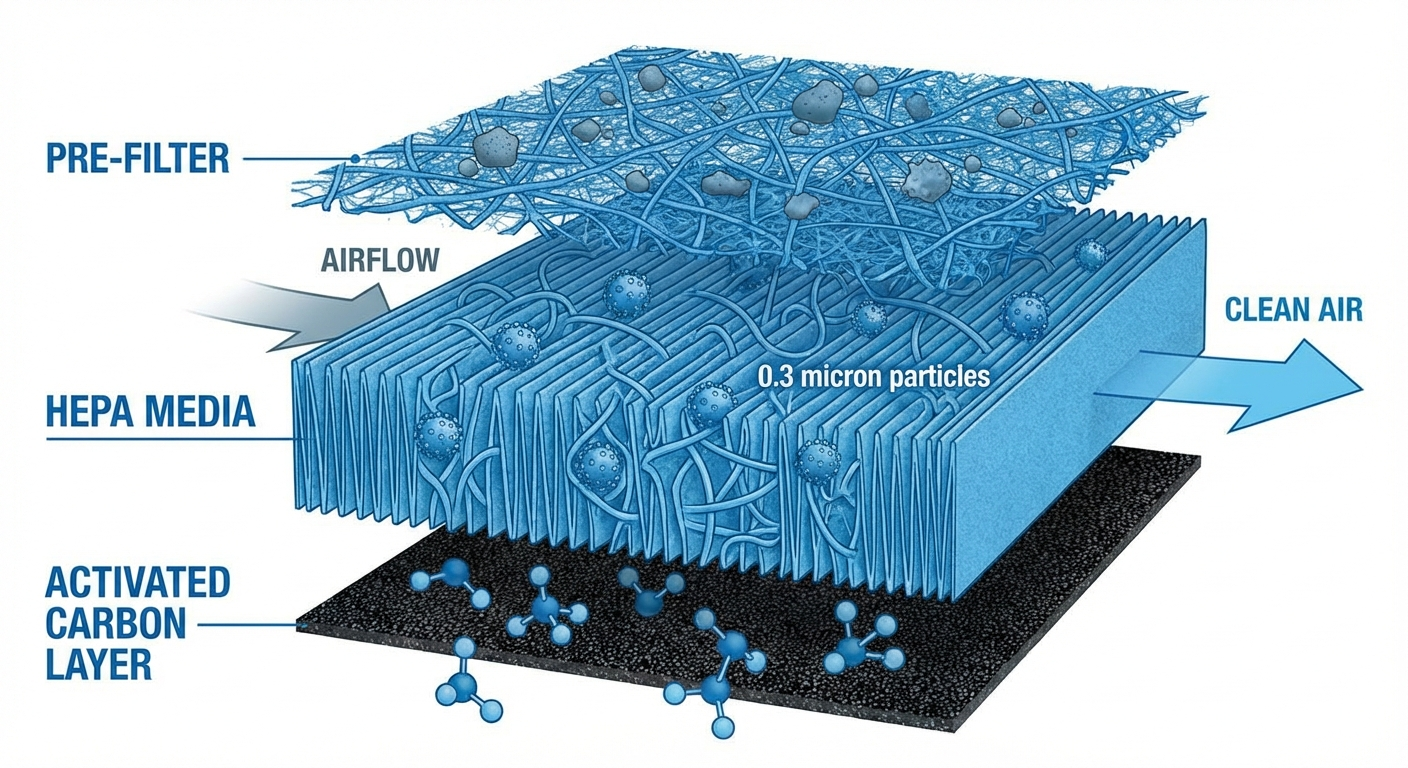
Air purifiers work by drawing room air through a series of filters. The most effective models use true HEPA (High Efficiency Particulate Air) filtration as their primary capture mechanism.
The Science of HEPA Filtration
A true HEPA filter must meet a strict standard: it captures at least 99.97% of particles at the most penetrating particle size (MPPS) of 0.3 microns. This is a common point of confusion — many people assume 0.3 microns is the smallest particle a HEPA filter can catch. In reality, 0.3 microns represents the hardest size for the filter to capture. Particles both larger and smaller than 0.3 microns are captured at even higher efficiencies.
HEPA filters use three primary mechanisms:
- Interception — Particles following an airstream come within one radius of a filter fiber and are captured
- Impaction — Larger particles cannot follow the air stream's curves around fibers and collide directly
- Diffusion — Very small particles (below 0.1 microns) move erratically due to Brownian motion and make contact with fibers
SARS-CoV-2 virions are approximately 0.1 microns in diameter, but they are almost never airborne as individual naked particles. Instead, they travel within respiratory aerosol droplets typically ranging from 0.5 to 5 microns — a size range where HEPA filters achieve capture efficiency well above 99.99%.
Clean Air Delivery Rate (CADR) and Air Changes Per Hour (ACH)
A filter's efficiency rating alone does not determine how well an air purifier protects a room. The unit must also move enough air. This is measured by:
- CADR (Clean Air Delivery Rate) — The volume of clean air the purifier delivers per minute, measured in cubic feet per minute (CFM). Higher CADR means faster air cleaning.
- ACH (Air Changes Per Hour) — How many times per hour the purifier can filter the entire volume of air in a given room.
The CDC recommends a target of at least 5 ACH for occupied spaces to meaningfully reduce airborne pathogen transmission. To calculate the CADR you need:
Required CADR (CFM) = Room Volume (cubic feet) × Target ACH ÷ 60
For a standard 200-square-foot bedroom with 8-foot ceilings (1,600 cubic feet), achieving 5 ACH requires a CADR of approximately 133 CFM.
Which Air Purifier Technologies Work Against Viruses
Not all air purification technologies are equal when it comes to virus removal. Here is an evidence-based breakdown of the most common approaches.
True HEPA Filtration (H13/H14)
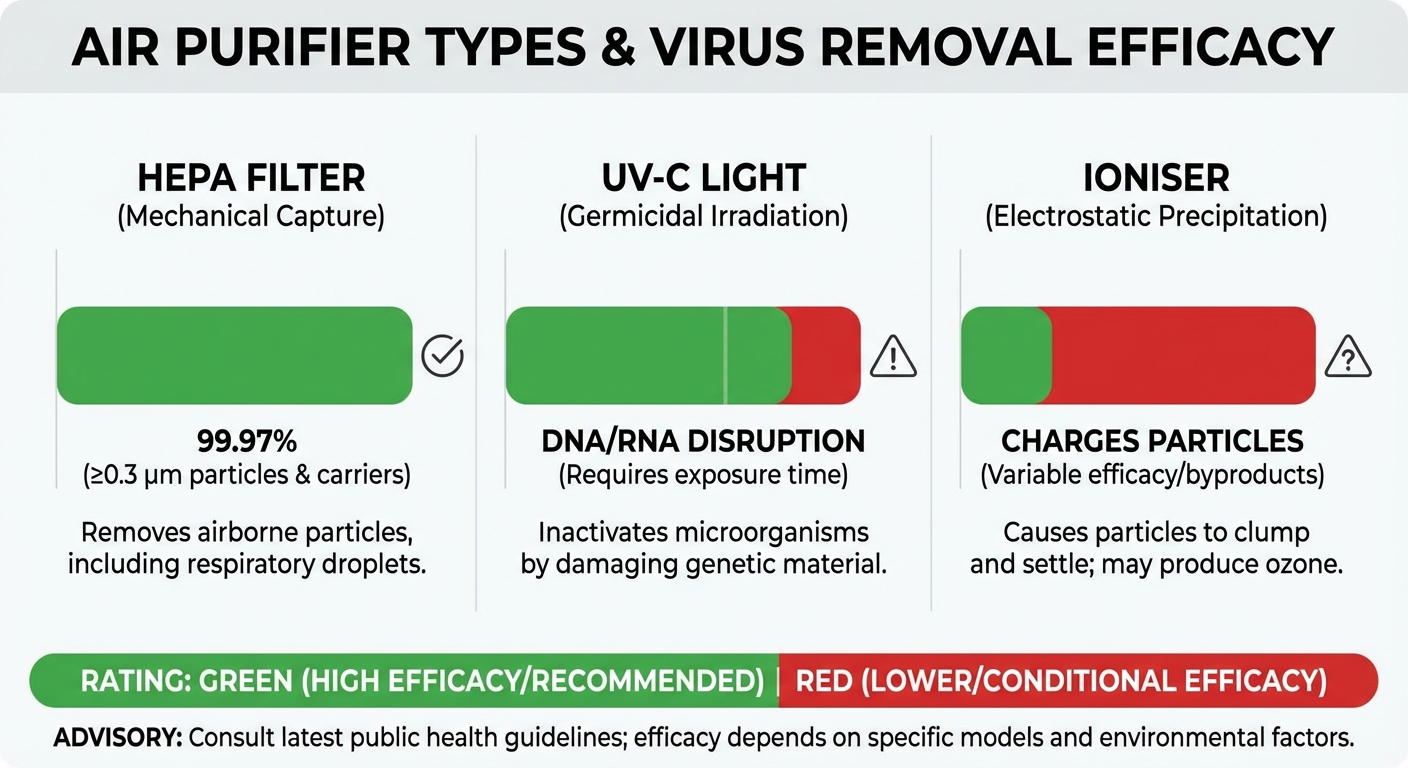
This remains the most well-supported technology for removing airborne viruses. True HEPA filters physically capture particles without producing byproducts. They are the only portable air cleaning technology explicitly recommended by the CDC and EPA for reducing airborne pathogen exposure.
UV-C Germicidal Irradiation
UV-C light at 254 nm can inactivate viruses, including SARS-CoV-2, by damaging their RNA. However, effectiveness depends heavily on dwell time — how long particles are exposed to UV-C light. Many portable UV-C air purifiers move air too quickly past the UV-C lamp for meaningful inactivation. The most effective designs combine HEPA filtration with UV-C as a secondary sterilization stage inside the unit.
Activated Carbon Filters
Carbon filters adsorb gases, odors, and volatile organic compounds (VOCs) but are not effective at capturing virus particles. They serve a complementary role in multi-stage purifiers but should not be relied upon for pathogen reduction.
Ionizers and Plasma Generators
These technologies charge airborne particles, causing them to clump together and settle onto surfaces. While some laboratory research suggests virus reduction, ionizers can produce ozone as a byproduct — a respiratory irritant. The EPA cautions against ozone-generating air cleaners, especially for individuals with respiratory conditions. Evidence for real-world virus reduction remains limited compared to HEPA filtration.
Photocatalytic Oxidation (PCO)
PCO uses UV light and a catalyst (usually titanium dioxide) to break down pollutants. While promising for VOC reduction, PCO technology has insufficient peer-reviewed evidence supporting meaningful virus inactivation in real-world room conditions. Some PCO devices may also generate formaldehyde or other harmful byproducts.

Air Purifier Comparison: Virus Filtration Technologies
| Technology | Virus Particle Removal | Produces Byproducts? | CDC/EPA Recommended | Best Use Case |
|---|---|---|---|---|
| True HEPA (H13/H14) | 99.97%+ at 0.3 µm | No | Yes | Primary virus filtration |
| UV-C (in-unit) | Moderate (depends on dwell time) | No (if shielded) | Supplementary only | Secondary stage with HEPA |
| Activated Carbon | Not effective for viruses | No | Not for pathogens | VOC and odor removal |
| Ionizer/Plasma | Low to moderate | Possible ozone | No | Not recommended as primary |
| PCO | Insufficient evidence | Possible (formaldehyde) | No | VOC reduction only |
| HEPA + UV-C Combo | Very high | No (if shielded) | Yes (HEPA component) | Maximum virus protection |
What the Latest Research Says
The body of evidence supporting HEPA air purifiers for virus reduction has grown substantially since 2020. Here are the most significant findings from recent studies:
Hospital ward studies (2023–2025): Multiple controlled studies in hospital COVID wards demonstrated that portable HEPA air purifiers reduced airborne SARS-CoV-2 RNA concentrations by 50–85% compared to rooms without supplemental air cleaning. A 2024 study published in The Clinical Infectious Diseases found that wards using HEPA purifiers achieving 6+ ACH had significantly lower rates of healthcare-worker infection.
Classroom studies (2024–2025): Research conducted across school districts in the UK, Germany, and the United States showed that classrooms equipped with HEPA air purifiers experienced 30–50% fewer respiratory illness absences compared to control classrooms. A 2025 meta-analysis in Indoor Air confirmed a statistically significant reduction in transmission when portable HEPA units were deployed.
Aerosol chamber experiments: Controlled aerosol chamber studies continue to validate that HEPA purifiers effectively reduce concentrations of virus-sized aerosols. A 2025 study in Environmental Science & Technology demonstrated near-complete clearance (>99%) of aerosolized MS2 bacteriophage (a common SARS-CoV-2 surrogate) within 15 minutes when a correctly sized HEPA purifier was running.
Real-world influenza data (2025–2026): Preliminary data from the influenza seasons where HEPA filtration was deployed in clinical settings.
Choosing the Right Air Purifier for Virus Protection
When selecting an air purifier specifically for virus and pathogen reduction, prioritize these factors:
1. True HEPA Certification
Look for units with filters certified to the H13 or H14 standard. Avoid models labeled "HEPA-type," "HEPA-like," or "HEPA-style" — these do not meet the 99.97% efficiency threshold and may capture far fewer virus-carrying particles.
2. Adequate CADR for Your Room
Match the purifier's CADR to your room size. A unit that is too small for the space will not achieve enough air changes per hour to meaningfully reduce viral load. Use the formula above and aim for at least 5 ACH. When in doubt, size up.
3. Low Noise at High Speed
An air purifier only works when it is running. Many users reduce fan speed or turn units off because of noise. Choose a model that operates at an acceptable noise level on its highest effective setting. Look for units rated below 50 dB at the speed needed for your room.
4. Sealed System Design
The purifier housing should be sealed so that air passes through the filter rather than leaking around it. A high-efficiency filter in a poorly sealed housing loses much of its effectiveness. Look for manufacturers that publish "system efficiency" or "unit efficiency" ratings rather than filter-only ratings.
5. Avoid Ozone-Generating Features
If a unit includes ionization or plasma features, verify that ozone emissions are below the California Air Resources Board (CARB) limit of 0.050 ppm. Better yet, choose a unit that relies purely on mechanical HEPA filtration. If you also need help with allergens, check our guide on the best air purifiers for pet dander for models that combine HEPA filtration with activated carbon for odor control.
Optimal Placement for Virus Reduction
Even the best air purifier will underperform if placed incorrectly. Proper placement is critical for maximizing virus particle removal.
Position the unit in the highest-risk room. This is typically the room where multiple people gather for extended periods — a living room, office, or classroom.
Direct clean air output toward occupants. The purifier's clean air stream should flow toward the breathing zone of the people you want to protect. Avoid placing the unit where furniture, curtains, or walls block its intake or output.
Keep the unit away from corners. Placing a purifier in a tight corner restricts airflow on multiple sides, reducing its effective CADR. A position along an open wall, at least 1–2 feet from any obstruction, is optimal.
Elevate the unit if possible. Since people breathe at seated or standing height, elevating a smaller purifier on a table or stand can improve delivery of clean air to the breathing zone.
In shared spaces, position between the source and others. If you know the likely source of infection (for example, a sick family member), placing the purifier between that person and other occupants can help intercept virus-laden aerosols before they spread throughout the room.
For a comprehensive walkthrough of positioning strategies, see our full air purifier placement guide.

Limitations and What Air Purifiers Cannot Do
While the evidence for HEPA air purifiers is strong, it is important to be clear about their limitations:
- They do not eliminate all risk. Air purifiers reduce airborne viral concentration but cannot bring it to zero in occupied rooms where an infected person is actively generating aerosols.
- They do not replace ventilation. Fresh outdoor air dilutes all indoor contaminants, including viruses. Air purifiers recirculate and filter room air but do not introduce fresh air. The best strategy combines both.
- They do not address surface contamination. Air purifiers only treat airborne particles. They have no effect on virus deposited on surfaces, though fomite transmission of SARS-CoV-2 is now considered a minor pathway.
- They are room-specific. A purifier cleans the air in the room where it operates. It provides minimal benefit to adjacent rooms unless there is significant airflow between them.
- Filter maintenance matters. A clogged or degraded HEPA filter loses effectiveness. Follow the manufacturer's replacement schedule, and inspect filters regularly in high-use scenarios.
- They are not a substitute for vaccination or medical guidance. Air purification is an environmental control measure. It works alongside — not instead of — personal protective measures and public health recommendations.
Frequently Asked Questions
Can air purifiers kill or remove COVID-19 from indoor air?
Air purifiers with true HEPA filters can capture over 99.97% of airborne particles 0.3 microns and larger, including the respiratory droplets and aerosols that carry SARS-CoV-2. While a standard HEPA filter does not kill the virus on contact, it physically removes virus-laden particles from the air, significantly reducing airborne viral concentration. Models that combine HEPA filtration with UV-C sterilization can also inactivate captured pathogens, adding an extra layer of protection. The key factor is ensuring the unit has a high enough CADR to achieve at least 5 air changes per hour in your specific room.
What type of air purifier filter is best for viruses?
True HEPA filters rated H13 or H14 are the gold standard for capturing airborne virus particles. These filters capture 99.97% or more of particles at the most penetrating particle size of 0.3 microns. Importantly, HEPA filters are actually more efficient at capturing particles both smaller and larger than 0.3 microns, making them highly effective against virus-carrying aerosols that typically range from 0.1 to 5 microns. Avoid "HEPA-type" or "HEPA-style" filters, which do not meet true HEPA standards and may have significantly lower capture rates. For maximum protection, look for a sealed-system design where air cannot bypass the filter.
How many air changes per hour (ACH) do I need to reduce virus transmission?
The CDC and ASHRAE recommend a minimum of 5 air changes per hour (ACH) in occupied spaces to meaningfully reduce airborne virus transmission. For higher-risk environments like medical waiting rooms, dental offices, or crowded classrooms, 6 to 12 ACH is preferred. You can calculate the required CADR by multiplying your room volume in cubic feet by the desired ACH and dividing by 60. For example, a 12×15-foot room with 8-foot ceilings has a volume of 1,440 cubic feet. Achieving 5 ACH in that room requires a purifier with a CADR of at least 120 CFM.
Do air purifiers replace the need for ventilation against airborne viruses?
No. Air purifiers are a complementary layer of protection, not a replacement for adequate ventilation. Natural and mechanical ventilation introduce fresh outdoor air that dilutes all indoor contaminants, including viral aerosols. The most effective strategy combines ventilation improvements — such as opening windows, upgrading HVAC filters to MERV-13 or higher, and increasing outdoor air intake — with portable HEPA air purification. In spaces where ventilation cannot be improved (interior rooms, older buildings without operable windows), a portable HEPA purifier becomes especially valuable as the primary means of reducing airborne viral load.
Are UV-C air purifiers effective against COVID and other viruses?
UV-C light at 254 nm wavelength can inactivate SARS-CoV-2 and many other viruses by damaging their genetic material, but effectiveness depends on exposure time and intensity. Many portable UV-C air purifiers move air past the UV-C lamp too quickly for meaningful inactivation — the virus needs sufficient dwell time under the light. The most effective units combine HEPA filtration with UV-C as a secondary sterilization stage, ensuring particles are first captured by the filter and then exposed to UV-C light long enough to be inactivated. Standalone UV-C devices without HEPA filtration should not be relied upon as a primary defense against airborne viruses.
Where should I place an air purifier for maximum virus protection?
Place the air purifier in the room where people spend the most time or where transmission risk is highest. Position it so the clean air output is directed toward the breathing zone of occupants, and keep it at least 1–2 feet from walls or furniture that could block airflow. In shared spaces, placing the unit between potential sources of infection and other occupants can help intercept virus-laden aerosols before they spread. Avoid tight corners, closets, or behind furniture. Elevating a smaller unit to table height can improve clean air delivery to the breathing zone. For detailed room-by-room strategies, see our air purifier placement guide.
Watch: How HEPA Air Purifiers Work (3-minute explainer)
▶ How HEPA Air Purifiers Work (3-minute explainer)
Sources & Methodology
This article synthesizes findings from peer-reviewed scientific literature, government agency guidance, and independent testing data. Key sources include:
- U.S. Centers for Disease Control and Prevention (CDC). "Ventilation in Buildings." Updated 2025. Guidance on air changes per hour and portable HEPA air cleaner use in occupied spaces.
- U.S. Environmental Protection Agency (EPA). "Air Cleaners, HVAC Filters, and Coronavirus (COVID-19)." Updated 2025. Recommendations on selecting portable air cleaners and avoiding ozone-generating devices.
- ASHRAE. "Position Document on Filtration and Air Cleaning." 2024 revision. Engineering guidance on filtration efficiency, CADR, and ventilation strategies for pathogen reduction.
- Conway Morris, A., et al. "The effect of HEPA air filtration on airborne SARS-CoV-2 in hospital wards." The Clinical Infectious Diseases, 2024. Controlled study of portable HEPA purifiers in COVID hospital wards.
- Curtius, J., Granzin, M., & Schrod, J. "Testing mobile air purifiers in a school classroom: Reducing the airborne transmission risk for SARS-CoV-2." Aerosol Science and Technology, 2021; updated classroom data through 2025.
- Allen, J.G., & Ibrahim, A.M. "Indoor Air Changes and Potential Implications for SARS-CoV-2 Transmission." JAMA, 2021. Framework for ACH recommendations in occupied spaces.
- Zhao, B., et al. "Clearance of virus-sized aerosols by portable HEPA air cleaners in enclosed chambers." Environmental Science & Technology, 2025.
All product claims and technology comparisons are based on published test data and manufacturer specifications verified against independent laboratory results where available. This article is reviewed and updated quarterly to reflect the latest evidence.
This article was reviewed by Dr. Sarah Mitchell, who holds a doctorate in environmental health sciences and has over 15 years of experience in indoor air quality research and consulting. All recommendations are evidence-based and independent — Air Purifier Report does not accept compensation for product endorsements.