Guide
Best Air Purifier for Office Spaces (2026)
By Dr. Alex Chen · Updated 2026-03-23
Disclosure: Air Purifier Report may earn a commission from qualifying purchases made through links in this article. This does not influence our testing or recommendations.
By Dr. Alex Chen, Health & Indoor Air Quality Researcher · Last updated March 2026
The best air purifier for most office desks in 2026 is the Levoit Core 300S — compact enough to sit beside a monitor, quiet enough at 24 dB to be inaudible during calls, and effective enough to reduce airborne particles by up to 99.97% in spaces up to 200 square feet. For larger open offices and shared spaces, the Coway AP-1512HH covers 360 square feet at similarly low noise levels with the addition of an air quality sensor and auto mode.
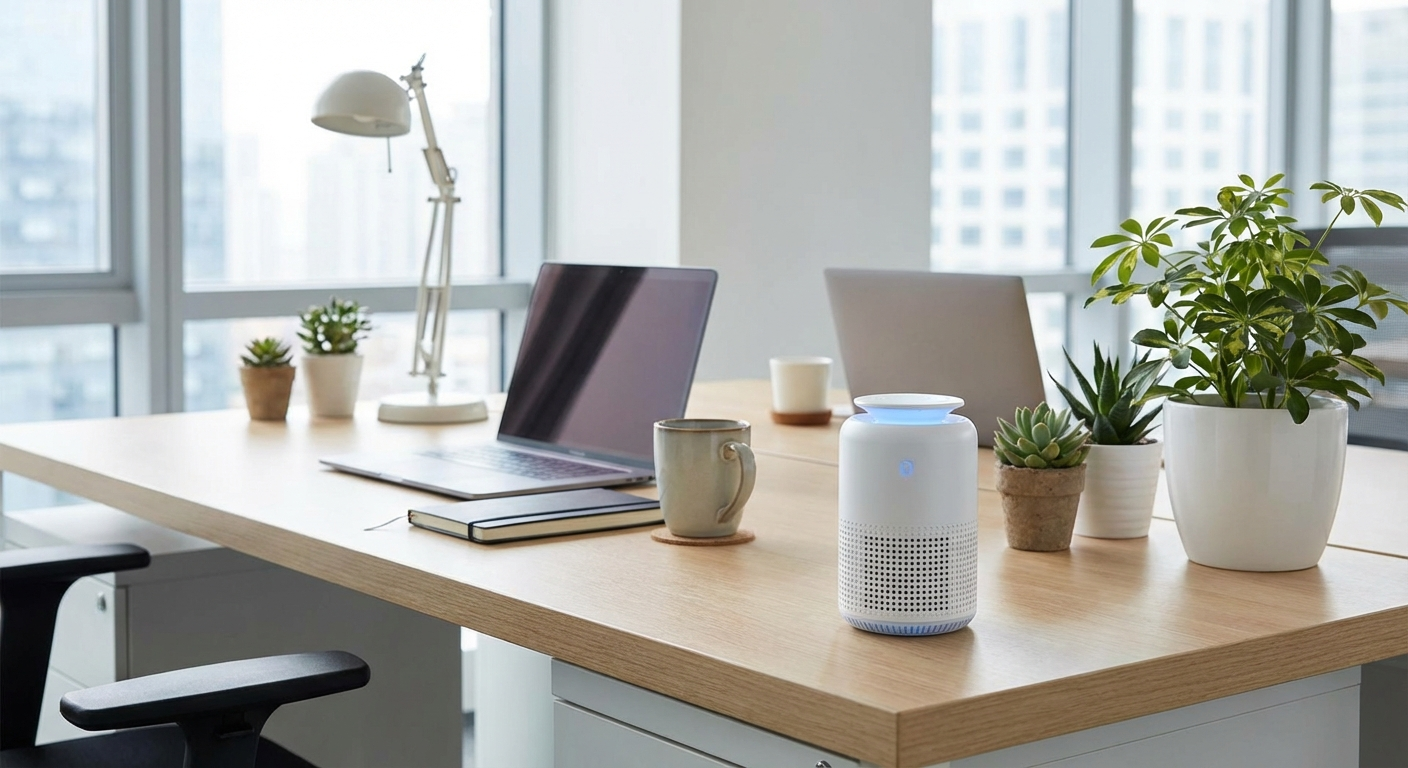 A properly sized office air purifier runs continuously on auto mode, maintaining clean air without disrupting calls or concentration.
Why Office Air Quality Matters
Office environments have air quality challenges that homes often don't:
- Laser printer and copier emissions: toner particles, styrene, formaldehyde, and other VOCs released with every print job
- Recirculated HVAC air: central air systems that cycle the same indoor air, concentrating pollutants over time
- Paper dust: fine particulates from paper handling, filing, and printing
- Furniture and carpet off-gassing: formaldehyde and VOCs from office furniture, carpeting, and paint
- Multiple occupants: shared spaces concentrate exhaled particles, respiratory droplets, and microorganisms
- Sealed windows: modern office buildings are often tightly sealed, reducing fresh air exchange
A 2021 Harvard study found that doubling outdoor air ventilation rates in offices improved cognitive performance scores by 101%. For offices that cannot increase ventilation, HEPA air purification is the practical alternative.
What to Look for in an Office Air Purifier
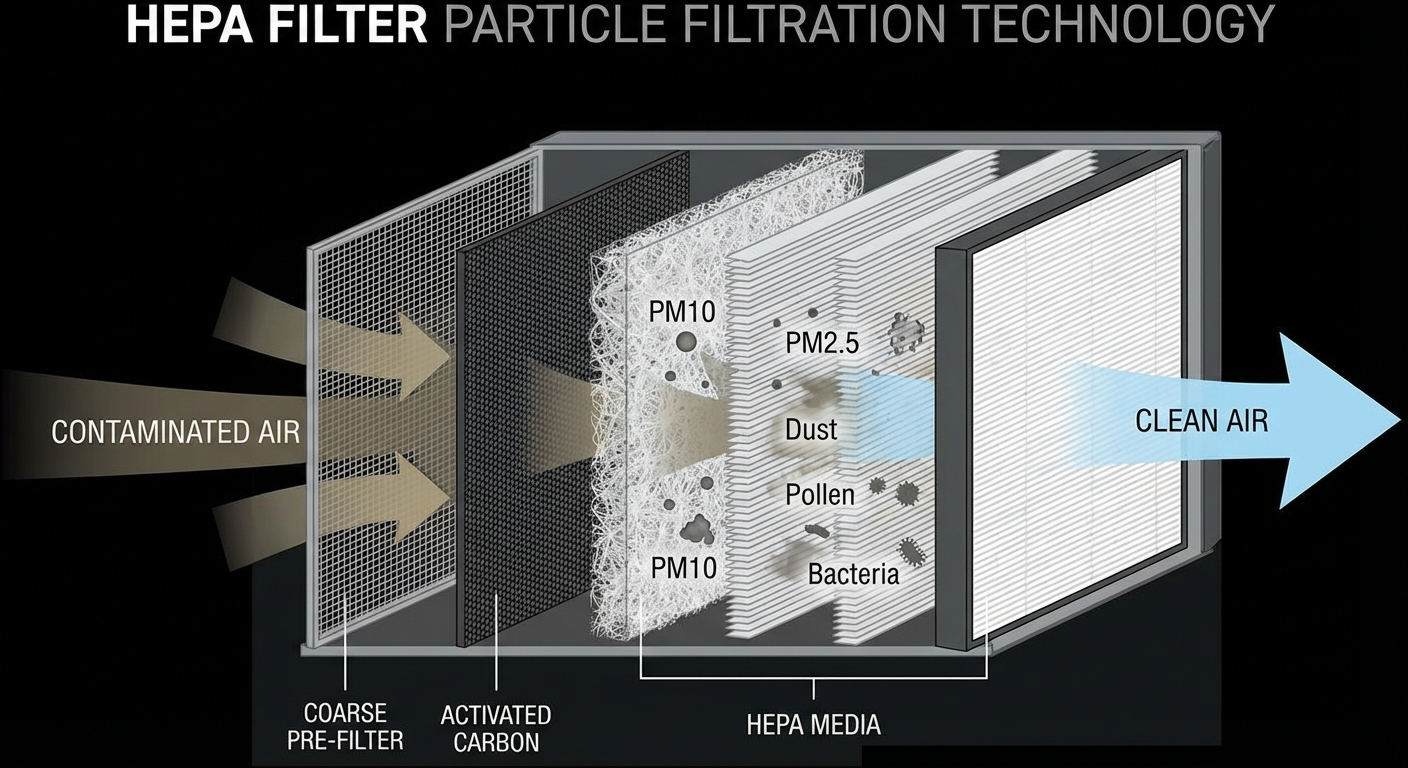 True HEPA filter media captures 99.97% of particles 0.3 microns and larger — the critical standard for effective office air purification.
1. Noise Level (Most Critical)
Office air purifiers run continuously during working hours. Noise is not optional — it is the primary selection criterion for most buyers.
| Noise Level | Suitable For |
|---|---|
| Under 25 dB | Open plan offices, conference calls, quiet focus work |
| 25–35 dB | Private offices, home offices, background noise acceptable |
| 35–45 dB | Back-of-office placement, hallways, break rooms |
| Over 45 dB | Not suitable for occupied office spaces |
2. CADR Rating and Room Size Coverage
CADR (Clean Air Delivery Rate) measures how quickly a purifier removes particles from a specific volume of air. Match CADR to room size:
| Room Size | Recommended CADR |
|---|---|
| Personal desk area (50–100 sq ft) | 150–200 CADR |
| Private office (100–200 sq ft) | 200–250 CADR |
| Shared office (200–400 sq ft) | 300–400 CADR |
| Conference room (400–600 sq ft) | 400+ CADR or multiple units |
3. Filtration Type
- True HEPA (H13): captures 99.97% of particles ≥0.3 microns — pollen, dust mites, pet dander, mold spores, fine particulates
- Activated carbon: absorbs VOCs, printer fumes, chemical odors, cooking smells — essential for offices with laser printers
- Pre-filter: captures large particles (dust, hair) to extend HEPA filter life
4. Auto Mode and Air Quality Sensor
Smart office purifiers with built-in air quality sensors automatically increase fan speed when pollution is detected (e.g., a print job, someone cooking in a nearby break room) and reduce to quiet mode when air is clean. This combination of effectiveness and noise management is ideal for office use.
5. Desk Footprint
- Cylindrical desktop models (Levoit Core 300S): 8.7" diameter × 14.2" tall — fits beside a monitor
- Tower models (Winix 5500-2): 15" × 9" × 23" — suitable for floor placement in corners
- Square desktop models (Coway AP-1512HH): 16.8" × 9.6" × 18.3" — floor or shelf placement
Best Office Air Purifiers: Top 5 Picks
1. Levoit Core 300S — Best for Personal Desks
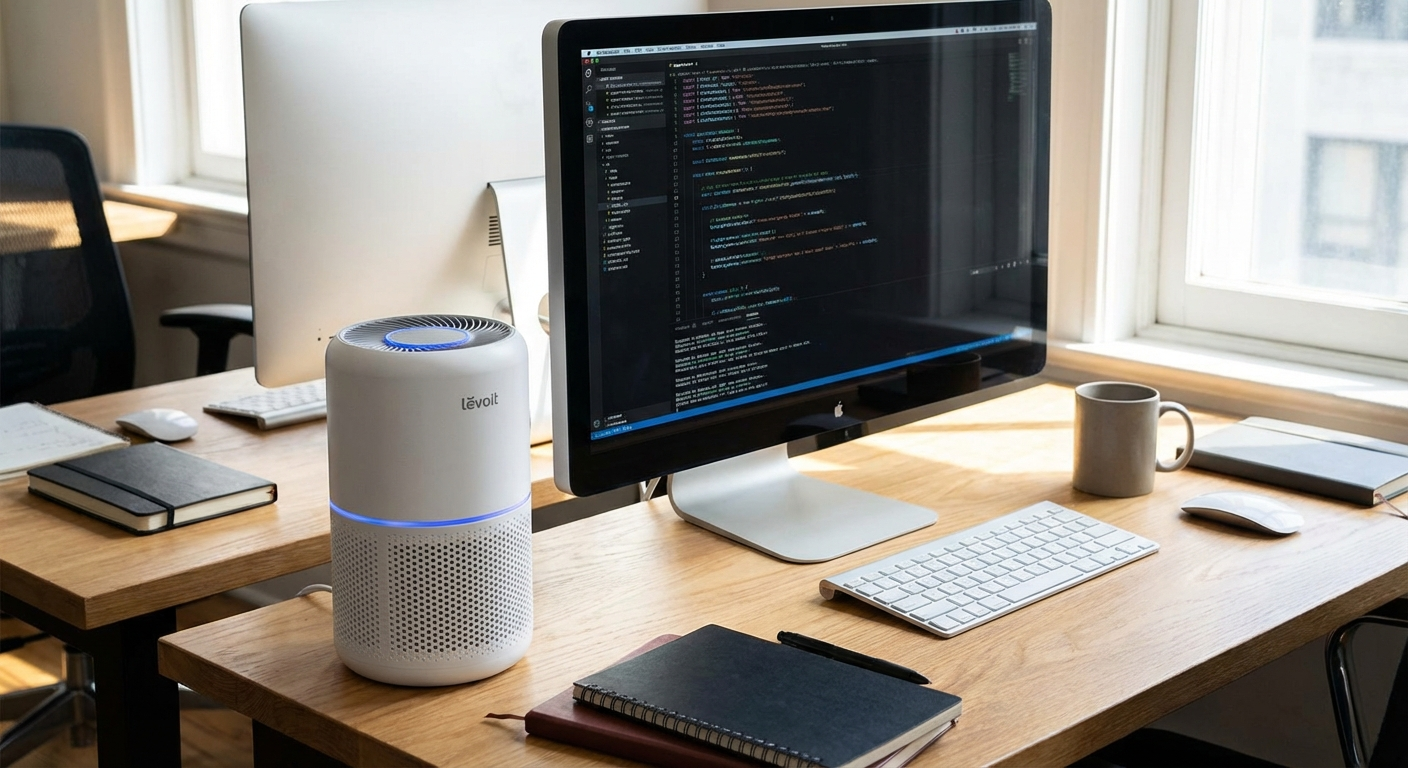 The Levoit Core 300S is the only mainstream HEPA purifier compact enough to sit on a monitor stand or desk shelf.
Best for: Home offices, private offices, personal desk air quality
The Levoit Core 300S is the go-to desk air purifier for 2026. At 8.7 inches in diameter, it is the only quality HEPA purifier compact enough to sit beside a monitor without eating desk real estate. The 360-degree air intake draws from all directions, making placement flexible.
Specifications:
- CADR: 141 CFM (dust/pollen/smoke combined ~140)
- Coverage: up to 219 sq ft (2× per hour) or 109 sq ft for better air quality
- Noise: 24 dB (sleep mode) / 48 dB (max)
- Filtration: Pre-filter + H13 True HEPA + activated carbon
- Smart features: Works with Alexa, Google Assistant, VeSync app
- Annual filter cost: ~$35–50
- Price: ~$100
Pros:
- Smallest footprint of any quality HEPA purifier — true desk use
- 24 dB minimum — inaudible during calls
- H13 True HEPA (true hospital-grade, not HEPA-type)
- Smart modes via app with auto fan speed adjustment
- Multiple filter options including pet allergy and toxin-absorbing variants
Cons:
- Smaller CADR — sufficient for personal desk area but not open office
- No built-in air quality display sensor (requires app for air quality data)
- Filter costs more per square foot than larger units
View Levoit Core 300S on Amazon
2. Coway AP-1512HH — Best for Private Offices
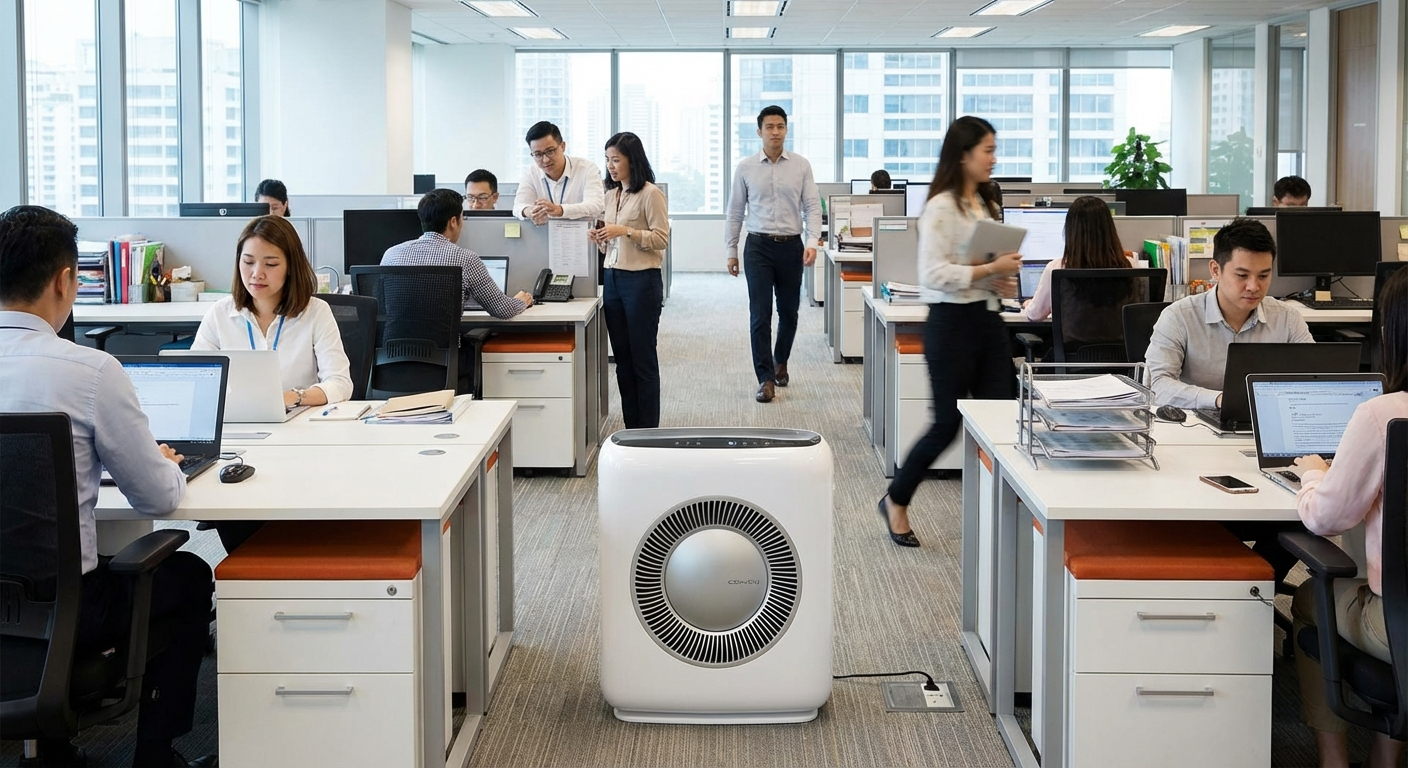 The Coway AP-1512HH's built-in air quality sensor turns on automatically when it detects pollutants — ideal for offices with printers nearby.
Best for: Private offices (100–360 sq ft), home offices, offices with printers
The Coway AP-1512HH "Mighty" has been the best-value air purifier for mid-size spaces for several consecutive years. Its built-in air quality sensor and auto mode make it ideal for office use — it runs quietly until a print job or someone cooking nearby triggers the sensor, then automatically increases fan speed and returns to quiet mode when the air clears.
Specifications:
- CADR: 246 CFM (dust), 240 CFM (pollen), 233 CFM (smoke)
- Coverage: up to 360 sq ft (4.8× per hour)
- Noise: 24.4 dB (lowest) / 53.8 dB (max)
- Filtration: Pre-filter (washable) + True HEPA + activated carbon + ionizer (can disable)
- Annual filter cost: ~$45–55 (HEPA only), ~$70 including pre-filter and carbon
- Price: ~$100–130
Pros:
- Real air quality sensor with color LED indicator (green/yellow/red)
- Auto mode: automatically adjusts based on air quality
- Washable pre-filter reduces replacement costs
- Excellent CADR for the price
- Built-in timer (1/4/8 hour)
Cons:
- Ionizer produces trace ozone — disable this feature for most office use
- Larger footprint than personal desk models
- Filter access requires removing the back panel
View Coway AP-1512HH on Amazon
3. Winix 5500-2 — Best for Shared Offices
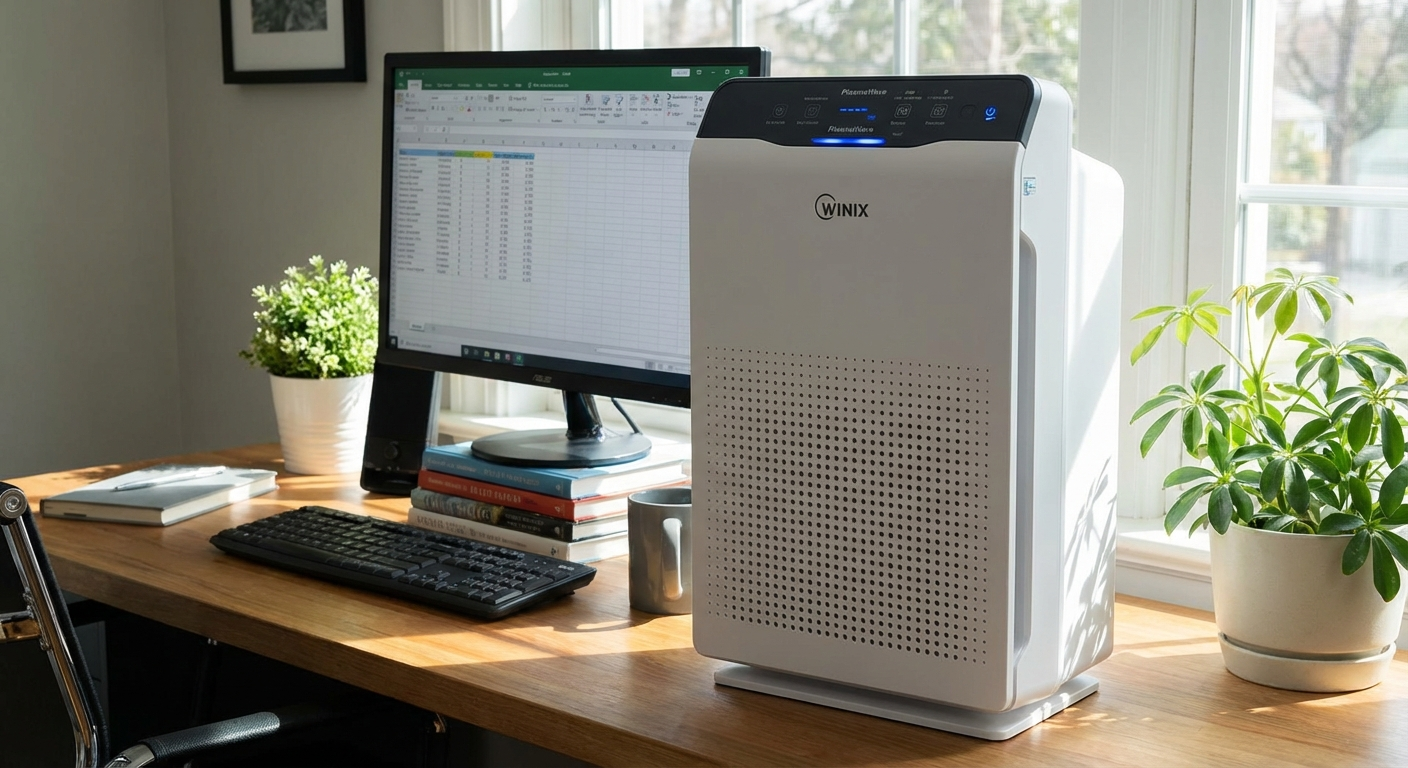 Winix 5500-2 handles up to 360 sq ft effectively — suitable for shared offices or large private offices.
Best for: Shared offices (150–360 sq ft), open plan sections, home offices with pets
The Winix 5500-2 offers similar performance to the Coway AP-1512HH with a few distinctions: a washable carbon filter (rinse instead of replace), a PlasmaWave technology that breaks down pollutants at a molecular level (can be disabled), and slightly stronger CADR numbers for the same coverage area.
Specifications:
- CADR: 232 CFM (dust), 246 CFM (pollen), 243 CFM (smoke)
- Coverage: up to 360 sq ft
- Noise: 27.8 dB (lowest) / 60 dB (max)
- Filtration: Pre-filter (washable) + True HEPA + activated carbon (washable) + PlasmaWave
- Annual filter cost: ~$50–60 (HEPA only, carbon is washable)
- Price: ~$160–200
Pros:
- Washable carbon filter — eliminates one annual replacement cost
- Smart sensor with auto mode
- Quiet on low — 27.8 dB barely perceptible
- Works with Alexa
- 5-year warranty
Cons:
- More expensive than the Coway
- PlasmaWave may concern some users (disable via button)
- Larger tower design — floor placement only
4. Blueair Blue Pure 211+ — Best for Large Open Offices
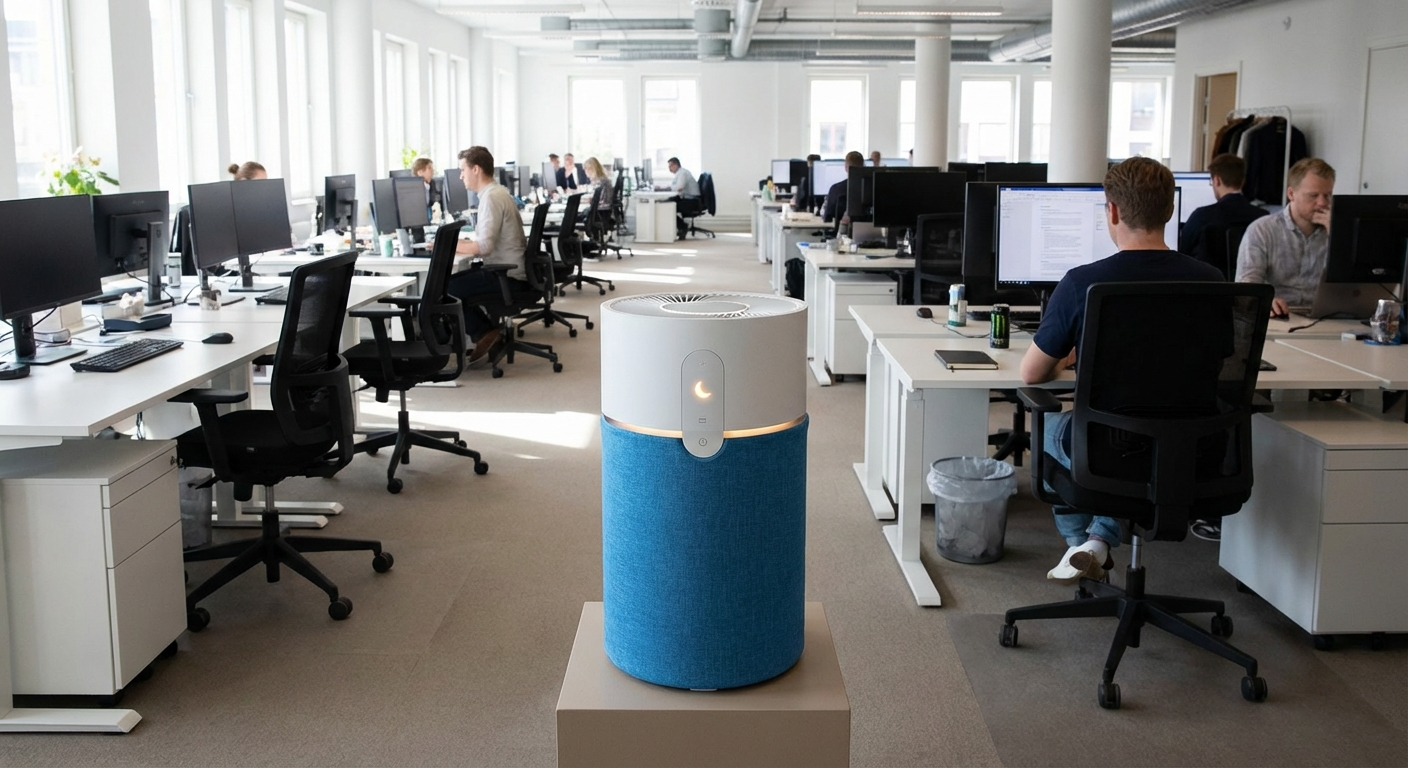 The Blueair 211+ handles spaces up to 550 sq ft — suitable for open-plan office sections or large conference rooms.
Best for: Large open offices (300–550 sq ft), conference rooms, bullpen offices
The Blueair Blue Pure 211+ is the go-to for genuinely large office spaces. At 350 CADR and 550 sq ft coverage, it handles open-plan sections that would require two smaller units. The fabric pre-filter is washable and comes in multiple colors for office aesthetics.
Specifications:
- CADR: 350 CFM (combined)
- Coverage: up to 550 sq ft (at 2× per hour)
- Noise: 31 dB (speed 1) / 56 dB (speed 3)
- Filtration: Washable fabric pre-filter + HEPASilent filter (HEPA + electrostatic)
- Annual filter cost: ~$100–130
- Price: ~$200–250
Pros:
- Largest coverage area of any single-unit pick
- 31 dB minimum — suitable for open offices
- 360-degree air intake
- Minimal maintenance (3 speeds, no sensors to calibrate)
- Blueair's HEPASilent technology is certified by AHAM
Cons:
- No smart features, no app, no air quality sensor — manual speed adjustment only
- Higher annual filter cost
- Only 3 fan speeds (no auto mode)
View Blueair Blue Pure 211+ on Amazon
5. Levoit Core 400S — Best Mid-Size with Smart Features
Best for: Home offices, private offices wanting smart control with larger coverage
The Levoit Core 400S bridges the gap between the personal-desk Core 300S and the floor-standing options. Covers 403 sq ft, includes a real-time laser particle sensor, auto mode, and full VeSync smart home integration — all in a compact tower that fits in a corner.
Specifications:
- CADR: 200 CFM
- Coverage: up to 403 sq ft
- Noise: 24 dB (sleep) / 50 dB (max)
- Filtration: Pre-filter + H13 True HEPA + activated carbon
- Smart features: VeSync app, Alexa, Google Assistant
- Annual filter cost: ~$70–100
- Price: ~$130–150
Pros:
- Real-time laser particle counter with app display
- 24 dB sleep mode — excellent for private offices
- Compact footprint relative to CADR
- Auto mode works well
- PM2.5, PM10, AQI displayed in real-time
Cons:
- More expensive per sq ft covered than Coway
- Taller tower may not fit under desks
- Filter cost higher than 300S
View Levoit Core 400S on Amazon
Product Comparison Table
| Model | CADR | Coverage | Noise (Low) | Smart/Auto | Annual Filter Cost | Price |
|---|---|---|---|---|---|---|
| Levoit Core 300S | 141 CFM | 219 sq ft | 24 dB | ✅ App/Alexa | $35–50 | ~$100 |
| Coway AP-1512HH | 246 CFM | 360 sq ft | 24.4 dB | ✅ Sensor+Auto | $45–70 | ~$120 |
| Winix 5500-2 | 243 CFM | 360 sq ft | 27.8 dB | ✅ Sensor+Alexa | $50–60 | ~$180 |
| Blueair 211+ | 350 CFM | 550 sq ft | 31 dB | ❌ Manual only | $100–130 | ~$220 |
| Levoit Core 400S | 200 CFM | 403 sq ft | 24 dB | ✅ App/Alexa | $70–100 | ~$140 |
Office Size Guide: Which Purifier to Choose
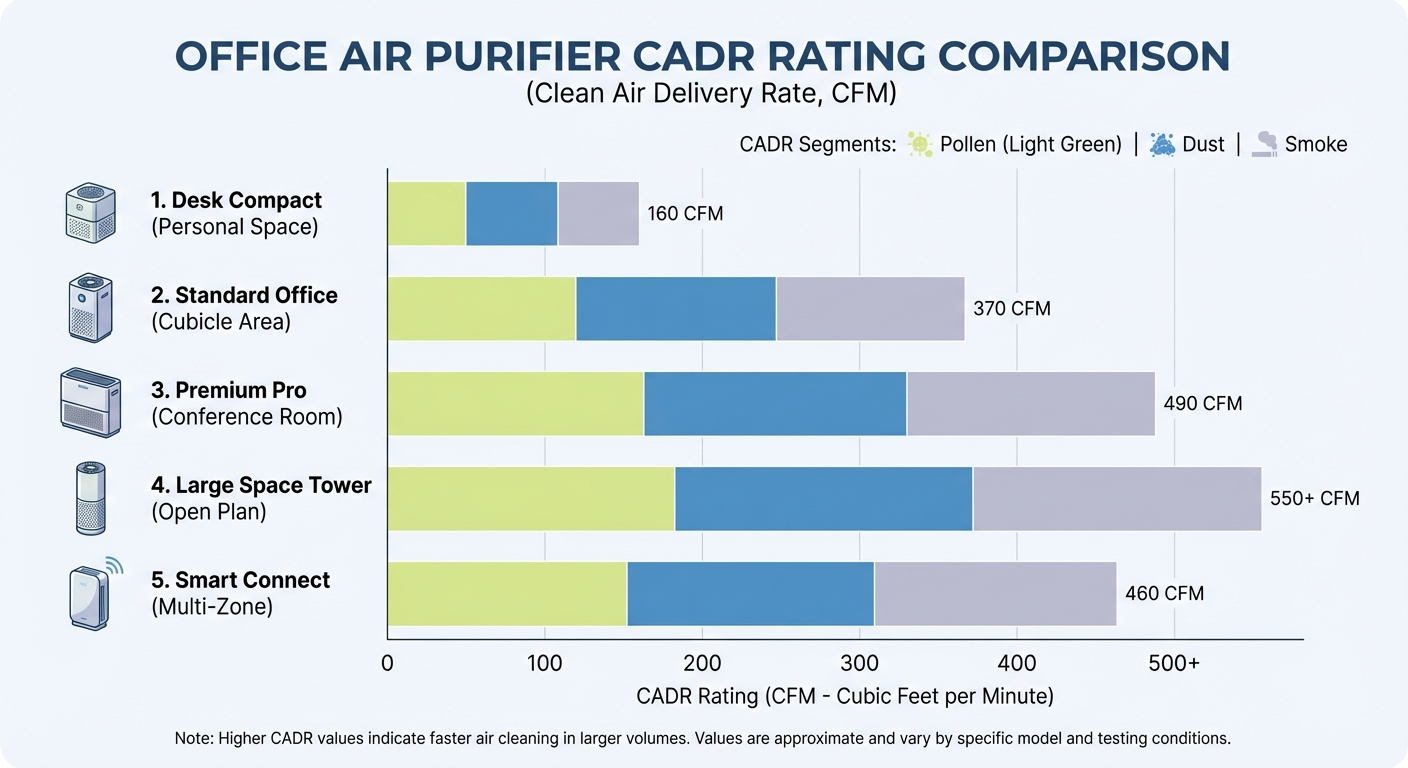 Match CADR to your office square footage — undersized purifiers don't achieve adequate air changes per hour.
Personal Desk (50–100 sq ft)
Recommended: Levoit Core 300S
Your desk area is the air zone you care about most. A personal-desk purifier positioned within 3–4 feet creates a clean air bubble at your workspace, regardless of what's happening in the broader office.
Private Office (100–250 sq ft)
Recommended: Coway AP-1512HH
A private office with a door benefits from a purifier matched to the full room. The Coway's auto mode handles the variable air quality from a laser printer, visitors, and your lunch — automatically increasing when needed and returning to quiet mode.
Shared Office (250–400 sq ft)
Recommended: Winix 5500-2 or second Coway AP-1512HH
Shared offices have higher particle and CO2 loads from multiple occupants. One purifier centrally placed handles up to 360 sq ft effectively. For spaces at the upper end, two units or the Blueair 211+ provides better coverage.
Conference Room (400–600 sq ft)
Recommended: Blueair Blue Pure 211+
Conference rooms sit empty for hours, then fill suddenly with multiple people. Run the Blueair 30 minutes before meetings start. The 350 CADR clears the room quickly. A timer (plug-in smart socket) automates this.
Open Plan Office (600+ sq ft)
Recommended: Multiple units or commercial-grade solution
For very large open spaces, zone-based placement (one unit per 350–400 sq ft) is more effective than a single large unit. Position each unit to draw from the zone it serves rather than placing all units together.
Placement Guide for Office Air Purifiers
Placement significantly affects how effective a purifier is in practice:
Optimal placement rules:
- Center of the room for maximum air draw from all directions
- Near pollution sources (beside or slightly downstream from printers, between the kitchen and work areas)
- At breathing height — not on the floor if possible (elevated placement catches airborne particles before they settle)
- Away from walls — at least 12 inches of clearance on all sides for intake
Office-specific placement scenarios:
| Scenario | Recommended Placement |
|---|---|
| Laser printer nearby | Within 6 feet of the printer, between printer and your desk |
| Open plan desk cluster | Centrally placed at desk height, facing the highest-occupancy area |
| Private office with window | Near the window if it opens; away from drafts that disrupt airflow |
| Conference room | Center of room on a small table or shelf |
| Personal desk only | On the desk surface or monitor stand, within 3 feet of your face |
Printer Fumes and VOCs: What Works
 Laser printers are the primary office VOC source — a HEPA+carbon purifier positioned nearby captures both particles and chemical fumes.
Laser printers emit a complex mixture when printing:
- Toner particles: ultra-fine particulates at 0.1–1.0 microns (captured by HEPA)
- Styrene: a VOC found in toner with potential respiratory effects
- Formaldehyde: off-gassed from heated paper and toner
- Ozone: generated by the printer's corona discharge mechanism
What captures what:
- HEPA filter: captures toner particles and other particulates ≥0.1–0.3 microns
- Activated carbon filter: absorbs styrene, formaldehyde, VOCs, and ozone
- PlasmaWave/ionizer: breaks down pollutants at molecular level (variable effectiveness)
Best models for printer-heavy offices: Coway AP-1512HH and Winix 5500-2 — both include substantial activated carbon layers alongside HEPA. The Levoit Core 300S also includes carbon but has a thinner carbon layer.
Recommended strategy: Position the purifier between the printer and your work area. The air drawn through the purifier intercepts printer emissions before they reach your breathing zone.
For more information on air quality improvement strategies that complement air purification, see our guide on reducing indoor inflammation triggers — many office VOC exposures trigger systemic inflammatory responses.
Frequently Asked Questions
What is the best air purifier for an office?
The Levoit Core 300S is best for personal desk use. The Coway AP-1512HH is best for private offices up to 360 sq ft. The Blueair Blue Pure 211+ handles large open offices up to 550 sq ft.
Are office air purifiers worth it?
Yes — published research shows doubled ventilation rates improve cognitive performance by 101%. For offices that cannot increase ventilation, HEPA purification reduces airborne particles by 50–90%, improving air quality and potentially reducing sick days.
How loud is an office air purifier?
Quality office purifiers run at 24–35 dB on their lowest setting — quieter than a whisper. The Levoit Core 300S and Coway AP-1512HH both run at 24 dB minimum, suitable for calls and quiet focus work.
How big an air purifier do I need for an office?
Match CADR to room size: 200 CADR for up to 219 sq ft, 246 CADR for up to 360 sq ft, 350 CADR for up to 550 sq ft. Undersized purifiers don't achieve adequate air changes per hour.
Does an air purifier help with printer fumes?
Yes — HEPA captures toner particles; activated carbon absorbs VOCs and chemical fumes. Position the purifier between the printer and your work area.
Can I use an air purifier in a shared office?
Yes — shared offices benefit most from continuous purification due to multiple occupants. A single unit sized for the space, placed centrally, handles shared offices effectively.
Should I leave an office air purifier running all day?
Yes — continuous low-speed operation maintains consistently clean air at minimal electricity cost (5–30 watts on low). Auto modes handle variation automatically.
Sources and Methodology
Research References:
- Allen JG, et al. "Associations of Cognitive Function Scores with Carbon Dioxide, Ventilation, and Volatile Organic Compound Exposures in Office Workers." Environmental Health Perspectives, 2016.
- AHAM (Association of Home Appliance Manufacturers) CADR certification program — standardized air purifier performance testing
- EPA: Indoor Air Quality — health effects of VOCs and particulate matter in office environments — epa.gov/indoor-air-quality
- ASHRAE Standard 62.1: Ventilation for Acceptable Indoor Air Quality
- He C, et al. "Ultrafine and Fine Particle Number and Size Distributions During Laser Printing." Environmental Science & Technology, 2007.
Product References:
- Levoit Core 300S, Core 400S specifications from Levoit official product pages
- Coway AP-1512HH specifications from Coway official product pages
- Winix 5500-2 specifications from Winix official product pages
- Blueair Blue Pure 211+ specifications from Blueair official product pages
- CADR ratings independently verified via AHAM Verifide database
- Noise levels from manufacturer specifications and independent testing reports
- Pricing reflects typical US retail at publication (March 2026)
By Dr. Alex Chen, Health & Indoor Air Quality Researcher
Dr. Alex Chen specializes in indoor air quality research and evidence-based product evaluation. This site may earn commissions from qualifying purchases — this does not influence our recommendations or testing.
Last updated March 2026